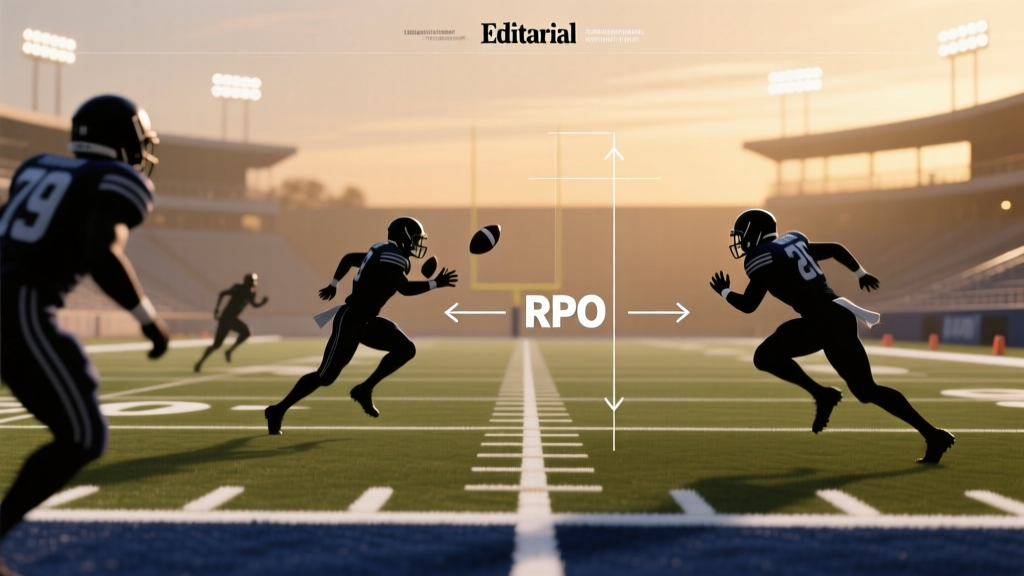
What Does RPO Mean in Football? Explained
In football, RPO stands for Run-Pass Option, a strategic play that allows the quarterback to decide at the last moment whether to hand the ball off for a run or throw a pass, based on how the defense aligns and reacts.
What Is an RPO in Football?
The Run-Pass Option (RPO) is an offensive play design that blends elements of both running and passing plays. Unlike traditional plays where the quarterback commits to a run or pass before the snap, an RPO gives the quarterback the flexibility to make that decision after the snap, depending on a specific defender's reaction—often called the "read defender." This real-time decision-making makes RPOs highly effective against aggressive or predictable defenses.
How RPOs Work
RPOs rely on quick post-snap reads by the quarterback. The offense runs a run play and a short-passing route simultaneously. The QB watches a key defender (typically a linebacker or safety). If that defender commits to stopping the run, the QB pulls the ball and throws the pass. If the defender drops into coverage, the QB hands the ball off.
- The offensive line typically blocks as if it's a run play.
- One receiver runs a quick passing route, such as a slant or bubble screen.
- The quarterback reads a designated defender within 1–2 seconds of the snap.
- The decision must be instantaneous—no hesitation.
Key Components of a Successful RPO
Read Defender
This is the player the quarterback watches to determine whether to pass or hand off. Misreading this defender can lead to turnovers or lost yardage.
Timing and Execution
RPOs require perfect timing between the quarterback, running back, and receivers. Even a half-second delay can disrupt the play’s effectiveness.
Offensive Line Discipline
The offensive linemen block downhill as if running the ball. They are not permitted to advance more than one yard downfield before a pass is thrown, per NFL and NCAA rules, or it results in a penalty.
RPO vs. Traditional Play-Action
While both RPOs and play-action passes aim to deceive the defense, they differ significantly:
| Feature | RPO | Play-Action |
|---|---|---|
| Decision Timing | Post-snap read | Preset pass |
| Blocking | Run blocking with one receiver route | Pass protection setup |
| Linemen Downfield | Limited to 1 yard pre-pass | No restriction after fake handoff |
| QB Action | True option: run or pass | Fake handoff, then pass |
| Speed of Decision | Under 2 seconds | After drop-back |
RPOs are faster, more dynamic, and place greater cognitive load on the quarterback. Play-action is more about misdirection and relies on deeper drops and longer-developing routes.
Advantages and Risks of RPOs
- Exploits defensive aggression: Forces defenders to hesitate, creating mismatches.
- Increases offensive efficiency: Maximizes yards after catch and creates running lanes.
- Reduces predictability: Keeps defenses guessing and prevents over-pursuit.
- Risk of penalties: Offensive linemen going beyond 1 yard downfield pre-pass draw a 5-yard penalty.
- Turnover risk: Poor reads can lead to interceptions or fumbles.
RPO Usage Across Leagues
| Team (Year) | Estimated RPOs per Game | % of Total Plays | Average Yards per RPO |
|---|---|---|---|
| Kansas City Chiefs (2024) | 8.7 | 18% | 6.9 |
| Philadelphia Eagles (2023) | 7.2 | 15% | 6.4 |
| Alabama Crimson Tide (2022) | 10.3 | 22% | 7.1 |
| San Francisco 49ers (2023) | 6.8 | 14% | 6.2 |
| Cincinnati Bengals (2024) | 5.4 | 11% | 5.8 |
Data shows that top-performing teams like the Chiefs and Alabama integrate RPOs heavily into their offensive schemes, averaging over 6 yards per attempt. College programs tend to use RPOs more frequently due to rule interpretations and less complex defensive schemes. In the NFL, increased defensive speed and stricter enforcement of downfield blocking have slightly limited RPO volume but not effectiveness.
Common Questions About RPO in Football
What does RPO stand for in football?
RPO stands for Run-Pass Option, a play that allows the quarterback to choose between handing the ball off for a run or throwing a short pass based on how a specific defender reacts after the snap.
When did RPO become popular in the NFL?
RPOs gained widespread popularity in the NFL around 2013–2015, led by coaches like Chip Kelly and teams such as the Philadelphia Eagles and Kansas City Chiefs. Their success in college football, especially in spread offenses, prompted NFL adoption.
Why can’t offensive linemen go downfield during an RPO?
According to NFL and NCAA rules, offensive linemen are prohibited from advancing more than one yard downfield before a forward pass is thrown. Violating this rule results in a 5-yard penalty for illegal blocking downfield, which is common in poorly executed RPOs.
Who are the best quarterbacks at executing RPOs?
Quarterbacks like Patrick Mahomes (Chiefs), Jalen Hurts (Eagles), and Joe Burrow (Bengals) are known for their elite RPO decision-making. In college, players like Bryce Young and Caleb Williams demonstrated high efficiency in RPO-heavy systems.
Are RPOs legal in all football leagues?
Yes, RPOs are legal in the NFL, NCAA, and high school football, but with strict enforcement of downfield blocking rules. While the play itself is allowed, improper execution by linemen can result in penalties.
More Articles
 What Channel Is the Seahawks Game On Today?
 Which Country Invented Football (Soccer)?
 How Long Is a Normal Football Game? Full Breakdown
 What Channel Is the Football Game Today? (Oct 2025)
 When Do Football Games End? Timing Explained by League
 Who Did Doug Flutie Play Football For? Teams & Career
 Who Is the Tallest Player in Football? Verified List 2025
 Which Team Has Most Super Bowl Wins? (Updated 2025)
 How Many Teams in College Football Playoffs?
 NFL Game Length: How Long Is a Football Game?