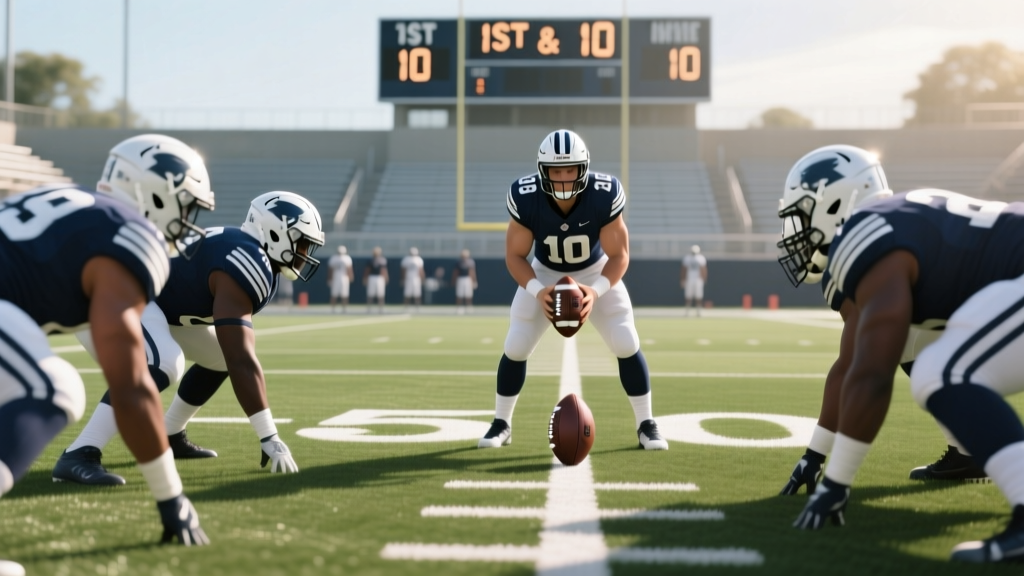
What Does 1st and 10 Mean in Football? Explained
What does 1st and 10 mean in football? In American football, “1st and 10” means it is first down with 10 yards to go for a new set of downs. This standard starting point occurs after most punts or incomplete passes, giving the offense four plays to advance the ball at least 10 yards and earn a fresh 1st down.
Understanding Football Down and Distance
In American football, the game revolves around gaining yardage in a series of attempts called downs. The offensive team has four chances (downs) to move the ball forward 10 yards. If they succeed, they earn a new set of four downs—a process known as getting a first down.
Breaking Down “1st and 10”
The term “1st and 10” specifically refers to:
- 1st: First down—the initial play in a series of four.
- 10: 10 yards needed to reach the next first down.
This situation typically arises after a punt, a turnover on downs, or an incomplete pass that stops the clock. It’s the most common starting point for offensive drives.
How Downs Work in Football
The down system structures each possession. Here’s how it progresses:
- 1st down: Team has four attempts to gain 10 yards.
- 2nd down: If less than 10 yards were gained on 1st down.
- 3rd down: Critical juncture; failure to gain enough here often leads to 4th down decisions.
- 4th down: Final attempt; teams may punt, attempt a field goal, or go for it.
Examples of Down and Distance Notation
| Notation | Meaning |
|---|---|
| 1st and 10 | First down, 10 yards to go |
| 2nd and 7 | Second down, 7 yards to go |
| 3rd and 1 | Third down, just 1 yard needed |
| 4th and Goal | Fourth down near the end zone, within 10 yards of scoring |
Strategic Importance of 1st and 10
Because 1st and 10 gives the offense maximum flexibility, it’s a crucial setup for controlling the game’s tempo. Coaches use this down to:
- Balanced play-calling: Mix running and passing plays.
- Set up future downs: Establish the run to open up play-action passes.
- Manage risk: Avoid negative-yardage plays that create difficult 2nd-and-long situations.
Why 1st and 10 Matters for Game Strategy
A successful 1st-down play significantly increases the chance of converting a full set of downs. According to NFL analytics, teams that gain 4+ yards on 1st and 10 convert the series over 70% of the time.
| Yards Gained on 1st & 10 | Series Conversion Rate | Average Drive Success Rate |
|---|---|---|
| 0-3 yards | 48% | 52% |
| 4-7 yards | 68% | 65% |
| 8+ yards | 85% | 78% |
Data shows that gaining at least 4 yards on 1st and 10 dramatically improves a team’s odds of sustaining a drive. Teams that consistently achieve mid-range gains on first down control possession and reduce defensive pressure.
When Does 1st and 10 Occur?
Common scenarios triggering a 1st and 10 include:
- After a kickoff return (start of possession)
- Following a punt
- After an incomplete pass on 3rd down
- Penalties that reset the down count
- Start of a new half or overtime
Frequently Asked Questions About 1st and 10 in Football
What happens if a team doesn’t gain 10 yards on 1st and 10?
If the offense fails to gain 10 yards within four downs, they turn the ball over on downs. The opposing team gains possession at the spot of the tackle or stoppage.
Can you have 1st and 10 inside the 10-yard line?
Yes. When a team is within 10 yards of the end zone, “1st and Goal” replaces “1st and X.” However, if a penalty moves the ball back, a team might face 1st and 10 from deep in their own territory.
Is 1st and 10 always exactly 10 yards?
Most commonly, yes. But after penalties or plays ending beyond the line to gain, the distance can be less (e.g., 1st and 5). “1st and 10” is used generically but technically applies only when exactly 10 yards are needed.
Why is 1st and 10 so common?
It’s the default reset point after punts, turnovers, or incomplete passes. Since drives often begin from these situations, 1st and 10 sets the foundation for offensive strategy.
Do all football leagues use 1st and 10?
Yes. The 1st and 10 system is standard in American football leagues including the NFL, NCAA, and high school football. Canadian football uses 1st and 10 as well, though the field and rules differ slightly.
More Articles
 What Does OTA Mean in Football? Explained
 Why Do Football Players Wear Face Paint? Explained
 When Is Football On Today? Live Game Times & Schedule
 How Many College Football Conferences Are There in 2025?
 What Teams Are Playing Football Tomorrow? Key Matches
 Who Is the Tallest Player in Football? Verified List 2025
 De La Salle Football Schedule 2026 | Dates & Times
 When Will College Football 26 Be on Game Pass?
 Did BYU Football Win Today? Final Score & Recap
 How Long Are Middle School Football Games?