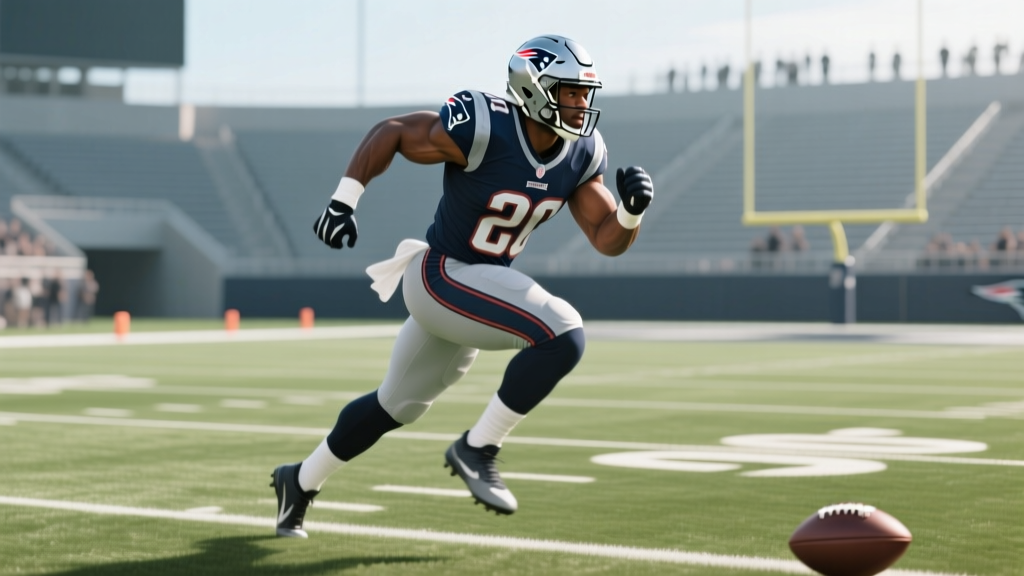
What Do Defensive Ends Do in Football? Key Roles Explained
Defensive ends in football are responsible for rushing the quarterback, stopping the run, and containing outside offensive plays. Positioned on the edges of the defensive line, they use speed, strength, and technique to disrupt the offense.
What Is a Defensive End in Football?
A defensive end (DE) is a key position on the defensive line in American football, typically aligned on the outermost edges opposite the offensive tackles. Their primary responsibilities include pressuring the quarterback, tackling running backs, and preventing outside runs. Defensive ends are essential in both 4-3 and 3-4 defensive schemes, though their specific roles may vary based on formation and team strategy.
Core Responsibilities of a Defensive End
- Rushing the passer to sack or pressure the quarterback
- Setting the edge to stop outside running plays
- Containing ball carriers on sweeps and tosses
- Disrupting blocking schemes with quickness and power
- Forcing fumbles through strip-sack techniques
Key Skills and Attributes of Elite Defensive Ends
Successful defensive ends combine physical prowess with mental discipline. They must read offensive formations quickly, react explosively, and maintain leverage against larger blockers.
Physical and Mental Traits
- Explosive first step: Crucial for beating offensive tackles off the snap
- Upper body strength: Needed to shed blocks and control gaps
- Long arms: Help keep linemen at bay and bat down passes
- Bend and flexibility: Allow players to dip under tackles and turn corners
- Football IQ: Understanding route concepts and play tendencies improves pass rush timing
Differences Between 4-3 and 3-4 Defensive Ends
The role of a defensive end changes depending on whether a team runs a 4-3 or 3-4 defense. In a 4-3, there are four down linemen, including two traditional defensive ends. In a 3-4, the defensive ends are often bigger and more focused on run-stopping, while outside linebackers handle most of the pass-rushing duties.
| Attribute | 4-3 Defensive End | 3-4 Defensive End |
|---|---|---|
| Weight Range (lbs) | 250–280 | 280–320 |
| Primary Role | Pass rushing | Run stopping |
| Alignment | Outside shoulder of OT | Head-up or 5-technique on OT |
| Common Techniques | Speed rush, swim move, rip move | Two-gap responsibility, bull rush |
| Notable Examples | Myles Garrett, Nick Bosa | Von Miller (early career), Justin Houston |
The data shows that 4-3 defensive ends tend to be lighter and more agile, optimized for attacking the quarterback. In contrast, 3-4 defensive ends are heavier and positioned to control multiple gaps, prioritizing run defense over pass rush production. This structural difference influences player development and draft evaluation.
Famous NFL Defensive Ends and Their Impact
Historically, dominant defensive ends have shaped eras of football. From Reggie White to Deacon Jones (who coined the term "sack"), these players revolutionized how defenses attack offenses.
- Myles Garrett (Cleveland Browns): Consistently ranks among league leaders in sacks and pressures
- Nick Bosa (San Francisco 49ers): Combines elite technique with high motor and football intelligence
- T.J. Watt (Pittsburgh Steelers): Blurs line between DE and OLB in 3-4 system, winning Defensive Player of the Year
- Chase Young (New Orleans Saints): Former No. 2 overall pick known for explosive pass-rush moves
Training and Development for Aspiring Defensive Ends
Developing into a high-level defensive end requires targeted training in several areas:
Off-Season Focus Areas
- Neural explosive drills (e.g., sled pushes, resistance band starts)
- Hand-fighting techniques against simulated blockers
- Flexibility and hip mobility work to improve edge-turning ability
- Video study of offensive tackles and quarterback drop times
- Core stability exercises to maintain pad level during contact
Frequently Asked Questions About Defensive Ends in Football
What does a defensive end do on passing plays?
On passing downs, defensive ends aim to rush the quarterback using speed, power, or counter moves. Their goal is to apply pressure, force hurried throws, or record a sack. They must also stay alert for screen passes and avoid being caught wide.
How is a defensive end different from a linebacker?
Defensive ends line up on the line of scrimmage and focus on penetrating the backfield, while linebackers typically stand behind the line and read plays before engaging. In 3-4 systems, outside linebackers often perform the pass-rushing role instead of the DE.
Do defensive ends cover receivers?
Rarely. While some hybrid edge rushers in certain schemes may drop into short zones (e.g., “spy” duty on mobile QBs), coverage is not a core responsibility. Most defensive ends are too large and lack the footwork for reliable man-to-man coverage.
Who are the top-rated defensive ends in the NFL today?
As of 2025, Myles Garrett, Nick Bosa, T.J. Watt, Haason Reddick, and Josh Allen (edge defender for the Jaguars) are among the highest-graded defensive ends by Pro Football Focus and NFL coaches.
Can a defensive end win Defensive Player of the Year?
Yes. Multiple defensive ends have won the AP Defensive Player of the Year award, including Aaron Donald (though primarily a DT), J.J. Watt, and T.J. Watt. Dominant sack numbers, tackles for loss, and forced turnovers increase a DE’s chances.
More Articles
 Who Is Playing NFL Football Tonight? Schedule & TV Info
 What Football Will Look Like in the Future
 What Came First: Football or Soccer?
 How Many Teams Are in SEC Football? 2025 Update
 Where Was Football Invented? The True Origin Explained
 Football Games on TV Today: Schedule & Channels
 Football Cleats by Position: What to Choose
 Did Kirk Herbstreit Play Football? Yes, at Ohio State
 NBC Football Announcers 2025: Full Broadcast Team
 How Many NFL Teams Are in Florida? (2025 Update)