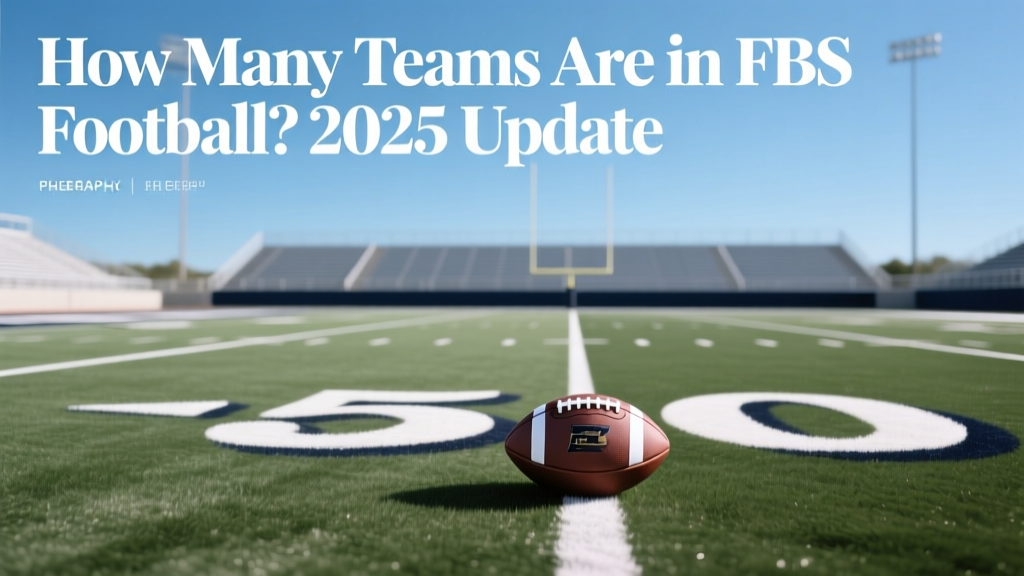
How Many Teams Are in FBS Football? 2025 Update
As of the 2025 season, there are 134 teams in the NCAA Football Bowl Subdivision (FBS), the highest level of college football in the United States. These teams are divided across 11 conferences and include independent programs, all eligible to compete for bowl games and a spot in the expanded College Football Playoff.
What Is FBS Football?
The Football Bowl Subdivision (FBS) is the top tier of NCAA Division I college football. Formerly known as Division I-A, FBS governs the largest and most competitive collegiate football programs in the U.S. Teams in this subdivision are distinguished by higher attendance requirements, larger athletic budgets, and eligibility to participate in postseason bowl games and the College Football Playoff.
Key Features of FBS Football
- Highest level of NCAA college football competition
- Minimum average home attendance requirement of 15,000 fans over a rolling two-year period
- Must play at least nine home games every four years against other FBS opponents
- Eligible for major bowl games and the 12-team College Football Playoff (starting in 2024)
- Greater media exposure and scholarship limits (85 full scholarships)
FBS Conference Breakdown
FBS teams are organized into 11 athletic conferences, each with its own scheduling format, championship game structure, and automatic access to specific bowl tie-ins. Some conferences have expanded recently due to realignment, affecting national competitiveness and geographic distribution.
Current FBS Conferences (2025 Season)
- American Athletic Conference (AAC)
- Atlantic Coast Conference (ACC)
- Big 12 Conference
- Big Ten Conference
- Pacific-12 Conference (Pac-12)*
- Conference USA (C-USA)
- Mid-American Conference (MAC)
- Mountain West Conference (MWC)
- Sun Belt Conference
- Independent Teams (not affiliated with a conference)
*Note: The Pac-12 currently operates with only two members but retains FBS status and scheduling agreements through 2025.
| Conference | Number of Teams | Notable Members | Home States (Primary) |
|---|---|---|---|
| ACC | 17 | Clemson, Florida State, Miami, SMU | FL, GA, NC, SC, VA, TX |
| Big Ten | 18 | Ohio State, Michigan, USC, Oregon, Penn State | IL, IN, IA, MI, MN, NJ, NY, OH, PA, CA, OR |
| Big 12 | 16 | Texas, Oklahoma, Kansas State, Arizona | TX, OK, KS, AZ, UT, CO, WV |
| AAC | 14 | Tulane, Memphis, Navy, Army (single-sport) | LA, TN, MS, AL, FL, MD, NY |
| Sun Belt | 14 | Appalachian State, Troy, James Madison | AL, AR, FL, GA, LA, NC, TX |
| Mountain West | 12 | Boise State, Fresno State, UNLV, Colorado State | CA, CO, ID, NV, NM, UT, WY |
| Mid-American (MAC) | 12 | Western Michigan, Toledo, Northern Illinois | OH, MI, NY, PA |
| Conference USA | 9 | Western Kentucky, Liberty, New Mexico State | AL, KY, LA, MS, NC, NM, TX |
| Pac-12 | 2 | Oregon State, Washington State | OR, WA |
| Independents | 4 | Notre Dame, UConn, UMass, Army (football-only) | CT, MA, NY |
| Total | 134 | - | - |
The table above shows the current distribution of FBS teams by conference as of the 2025 season. The Big Ten leads with 18 teams following expansion into the West Coast, while the Pac-12 has dwindled to just two members. Conference USA and the Sun Belt maintain strong regional footprints despite recent departures. Notre Dame remains the most prominent independent, though it has scheduling agreements with the ACC.
Recent Changes and Realignment Trends
The FBS landscape has undergone significant transformation between 2021 and 2025 due to conference realignment driven by media rights deals and financial incentives. Key changes include:
- Expansion of the Big Ten and ACC with schools from the former Pac-12 and Big 12
- Departure of Texas and Oklahoma to the SEC (effective 2024)
- Army joining the AAC as a football-only member in 2024
- UConn and UMass remaining as FBS independents after failed conference invitations
- Formation of scheduling alliances among smaller conferences to preserve bowl eligibility
These shifts reflect a broader trend toward consolidation among power conferences, increasing competitive imbalance but also elevating national exposure for select mid-major programs.
How Teams Qualify for FBS Status
To be classified as an FBS team, institutions must meet specific NCAA criteria:
- Average at least 15,000 in home attendance over a two-year period (or generate $1 million in annual football revenue)
- Sponsor at least 16 varsity sports teams
- Play a minimum of nine home football games every four years against FBS opponents
- Offer 85 full football scholarships
- Meet minimum scheduling standards (at least four non-powers or one Group of Five opponent per year)
Teams transitioning from the Football Championship Subdivision (FCS) must undergo a two-year reclassification process before gaining full FBS and bowl eligibility.
Frequently Asked Questions About FBS Football Teams
How many teams are in FBS football in 2025?
There are 134 teams in the NCAA Football Bowl Subdivision (FBS) for the 2025 season, spread across 11 conferences and including four independent programs.
Why does the Pac-12 still exist with only two teams?
The Pac-12 retains its FBS conference status through legal and television rights agreements until at least 2025. Oregon State and Washington State continue to operate the conference brand and have scheduling partnerships with the Mountain West to fulfill league requirements.
Which conferences make up the 'Power Four' in FBS?
The Power Four consists of the ACC, Big Ten, Big 12, and SEC. These conferences receive preferential treatment in the College Football Playoff, including automatic bids and greater representation in major bowls.
Can FBS independent teams play in the College Football Playoff?
Yes, FBS independent teams like Notre Dame can qualify for the 12-team College Football Playoff if they are ranked in the top 12 by the selection committee. However, they do not receive automatic qualification like conference champions.
What happens if an FBS team fails to meet attendance requirements?
If a school fails to meet the 15,000 average home attendance requirement over two years, it may be reclassified to the FCS unless it meets the alternative financial threshold of $1 million in annual football revenue.
More Articles
 How Many Acres in a Football Pitch? Size Explained
 Who Made Football? History & Origins Explained
 What Does a Football Tight End Do? Key Roles Explained
 When Does College Football 26 Come Out? Release Date Info
 How Long Does a Football Game Last on TV?
 When Is NFL Football Season? 2025 Schedule & Key Dates
 How Many National Championships Does Michigan Football Have?
 Where Do USC Trojans Play Football? Home Stadium Info
 How Many People Play Football Worldwide?
 Who Plays Football Tomorrow in the NFL?