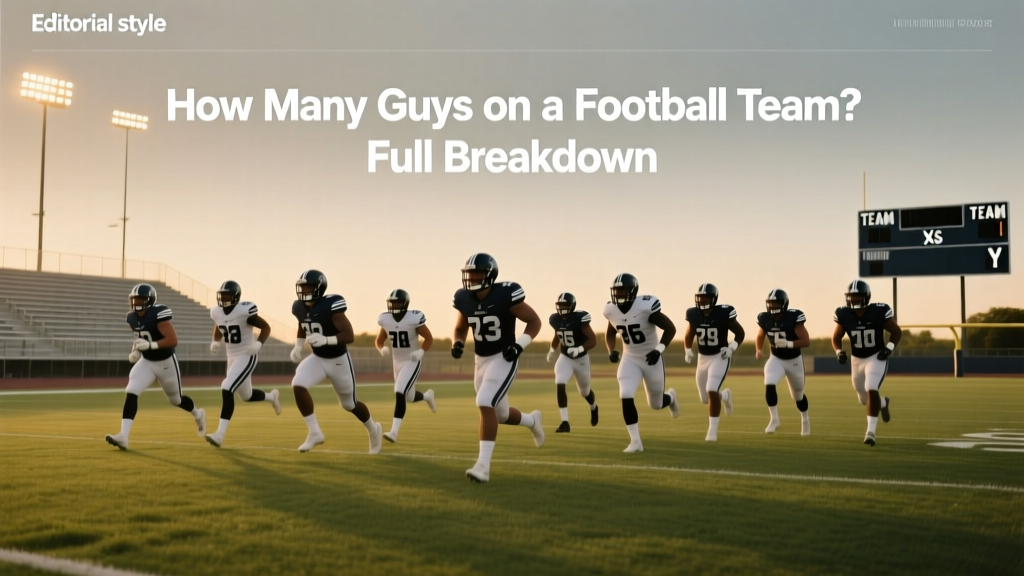
How Many Guys on a Football Team? Full Breakdown
There are 11 players from each team on the field at any one time in a regulation American football game, making up a full roster of typically 45 to 53 players depending on the league level.
Understanding Football Team Size: On-Field and Roster Limits
American football teams consist of two components: the number of players actively participating during gameplay and the total roster size. While only 11 players per side are allowed on the field simultaneously, teams maintain larger rosters to account for substitutions, injuries, and specialized roles across offense, defense, and special teams units.
Why Only 11 Players Are Allowed on the Field
The limit of 11 players per team on the field is standardized by the National Football League (NFL), NCAA (college football), and high school leagues (NFHS). This rule ensures balanced competition and strategic depth:
- Prevents overcrowding and maintains safety standards
- Encourages strategic player rotation and specialization
- Standardizes formations and play design across all levels
Exceeding 11 players on the field results in a penalty—typically a 5-yard infraction for illegal substitution or too many men on the field.
Roster Sizes Across Different Football Leagues
While the on-field count remains consistent at 11 players, total roster sizes vary significantly based on competition level, league rules, and season phase.
| League/Level | Active Game Day Players | Total Roster Size | Practice Squad Size |
|---|---|---|---|
| NFL | 46–53 (game active) | 53 | 16 |
| NCAA Division I (FBS) | 85 (scholarship players) | 105–125 (total roster) | N/A |
| High School (NFHS) | Variable | 40–90 | N/A |
| Youth Football (Pop Warner) | 11 per side | 20–35 | N/A |
The data shows that while all levels adhere to the 11-player rule on the field, professional and college programs maintain much deeper rosters. The NFL’s 53-player limit allows flexibility across game-day strategies, while college teams often carry over 100 players due to developmental needs and scholarship limits.
Breakdown of Player Roles by Unit
Football teams are divided into three main units, each with specific positions and responsibilities. Although only 11 players from each unit are on the field at once, multiple athletes rotate through these roles.
Offense (11 players on field)
- Quarterback (QB)
- Running Back (RB)
- Wide Receivers (WR) – typically 2–3
- Tight End (TE)
- Offensive Line (OL) – 5 players: LT, LG, C, RG, RT
Defense (11 players on field)
- Defensive Line (DL) – 3–4 players
- Linebackers (LB) – 3–4 players
- Cornerbacks (CB) – 2–4 players
- Safeties (S) – 2 players (FS, SS)
Special Teams (11 players on field)
- Kicker (K)
- Punter (P)
- Long Snapper (LS)
- Return Specialists
- Blocking and coverage units
Many players specialize in only one unit, while others contribute across multiple areas—especially in high school or youth leagues where rosters are smaller.
Frequently Asked Questions About Football Team Size
How many guys are on a football team during a game?
Exactly 11 players from each team are allowed on the field during gameplay in American football. This number is consistent across the NFL, college, and high school levels.
What is the maximum roster size in the NFL?
The NFL regular-season roster limit is 53 players. Of these, up to 48 can be active on game day, with 46 typically dressing for each game depending on team decisions.
Do college football teams have more players than NFL teams?
Yes, in total numbers. NCAA FBS teams can offer up to 85 scholarships but often carry 105–125 players on their full rosters, including walk-ons. While the NFL caps at 53, college teams manage larger overall squads due to developmental and academic factors.
Can a football team play with fewer than 11 players?
Yes. Teams may legally have fewer than 11 players on the field, though it's rare. This might happen due to injury, substitution miscommunication, or tactical bluffing. However, having more than 11 results in a penalty.
How many quarterbacks are usually on a football team?
In the NFL, teams typically carry 3 quarterbacks on their 53-man roster. College teams may have 4 or more due to redshirting and development pipelines. At lower levels, teams often have 1–2 QBs due to smaller rosters.
More Articles
 Football Field Width: Standard Size in Yards & Feet
 When is the Football World Cup? 2026 Dates & Details
 Who Plays NFL Football? Players, Positions & Facts
 How Many Points Is a Field Goal in Football?
 Live Football Games Today | SportsGearDaily
 Did Messi Retire From International Football? (2025 Update)
 Where Is the College Football Championship 2025?
 Who Plays Tomorrow Night on Thursday Night Football?
 When Did Football Begin? Origins & History Explained
 Who Is the GOAT of American Football? Tom Brady