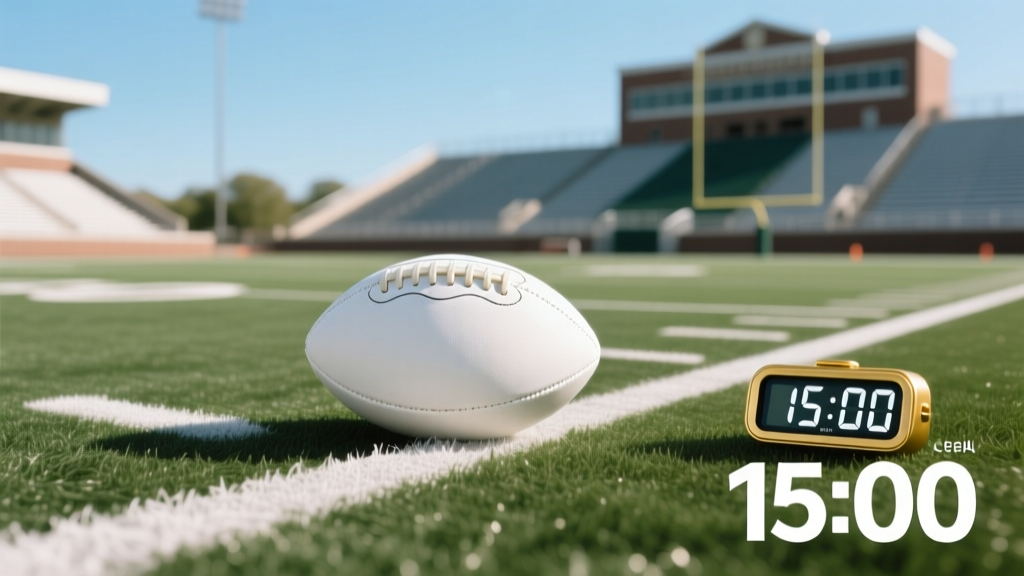
How Long Are Quarters in College Football?
College football quarters are 15 minutes long, matching the duration used in the NFL and high school football. Each game consists of four quarters, totaling 60 minutes of regulation play time. However, actual game duration typically exceeds three hours due to stoppages, timeouts, halftime, and broadcast breaks.
Understanding Quarter Length in College Football
Each quarter in a college football game lasts 15 minutes, as defined by the NCAA rulebook. While the clock runs continuously during live play, numerous factors extend the real-time length of a game far beyond the 60 minutes on the official clock.
What Causes Delays During Quarters?
- Incomplete passes: The clock stops until the next snap.
- Out-of-bounds plays: The clock stops if a player with the ball goes out of bounds.
- Timeouts: Each team gets three per half, pausing the clock for strategic discussions.
- Scores and turnovers: The clock stops after touchdowns, field goals, fumbles, and interceptions.
- Two-minute warning: In FBS games, the clock stops briefly at the two-minute mark of each half.
Comparison Across Football Leagues
While college football uses 15-minute quarters, slight differences in timing rules affect overall game flow. Below is a comparison of quarter length and related timing rules across major football leagues.
| League | Quarter Duration | Timeouts per Half | Halftime Duration | Two-Minute Warning |
|---|---|---|---|---|
| NCAA (FBS/FCS) | 15 minutes | 3 | 20 minutes | Yes (FBS only) |
| NFL | 15 minutes | 3 | 12 minutes | Yes |
| High School | 12 minutes | 3–5 (varies by state) | 10–20 minutes | No |
| CFL | 15 minutes | 1 per quarter | 10 minutes | Yes |
The data shows that while NCAA and NFL share identical quarter lengths and timeout counts, the FBS includes a two-minute warning similar to the NFL, which impacts end-of-half strategy. High school games are notably shorter with 12-minute quarters, while the CFL allows fewer timeouts but maintains 15-minute quarters.
Overtime Rules and Quarter Implications
When regulation ends in a tie, college football uses an overtime format that does not follow standard quarter timing. Instead, each team gets alternating possessions starting from the opponent’s 25-yard line. Starting in 2021, the NCAA implemented a rule where teams must attempt a 2-point conversion after scoring a touchdown in the second overtime period. Extra possessions continue until one team leads at the end of a full round.
How Overtime Differs from Regular Quarters
- No running clock; each possession operates under modified timing rules.
- Each overtime period is effectively a 3-minute quarter, though structured as possessions.
- Teams do not kick off; possession alternates regardless of score.
- Timeouts from regulation carry over into overtime.
Common Questions About College Football Quarters
How long is halftime in college football?
Halftime in NCAA football is 20 minutes long, providing teams time to regroup and allowing for extended entertainment such as marching band performances. This is longer than the NFL’s 12-minute halftime.
Do all college football games have 15-minute quarters?
Yes, all NCAA-sanctioned football games—whether FBS, FCS, Division II, or III—use 15-minute quarters. The timing structure is standardized across divisions.
Why do college football games take so long if quarters are only 15 minutes?
Although each quarter is 15 minutes, frequent stoppages for incomplete passes, timeouts, reviews, injuries, and media breaks significantly extend game duration. The average FBS game in 2024 lasted approximately 3 hours and 22 minutes.
Is the clock stopped after a first down in college football?
No, unlike some high school levels, the clock continues after a first down in college football. The game only stops for specific events like out-of-bounds plays, incomplete passes, or official reviews.
Are there any exceptions to the 15-minute quarter rule?
No official exceptions exist within NCAA regulations. However, in extreme weather or emergency situations, officials may pause the game, but the quarter length remains unchanged once play resumes.
More Articles
 What Does a Red Card Mean in Football?
 Who Is UTEP Football? Team Overview & Facts
 What Do OTAs Stand For in Football? Explained
 Where Was Football Invented? The True Origin Explained
 Who Plays Thanksgiving Football? NFL Teams & Schedule
 Largest Football Stadiums in the United States
 IU Football Game Today Start Time, TV Channel, Live Stream
 How Many NFL Teams Are There? Full 2025 Breakdown
 Who Plays Tonight in Football? Key Matches & Viewing Guide
 How Much Does a Football Weigh? Official Weights by League