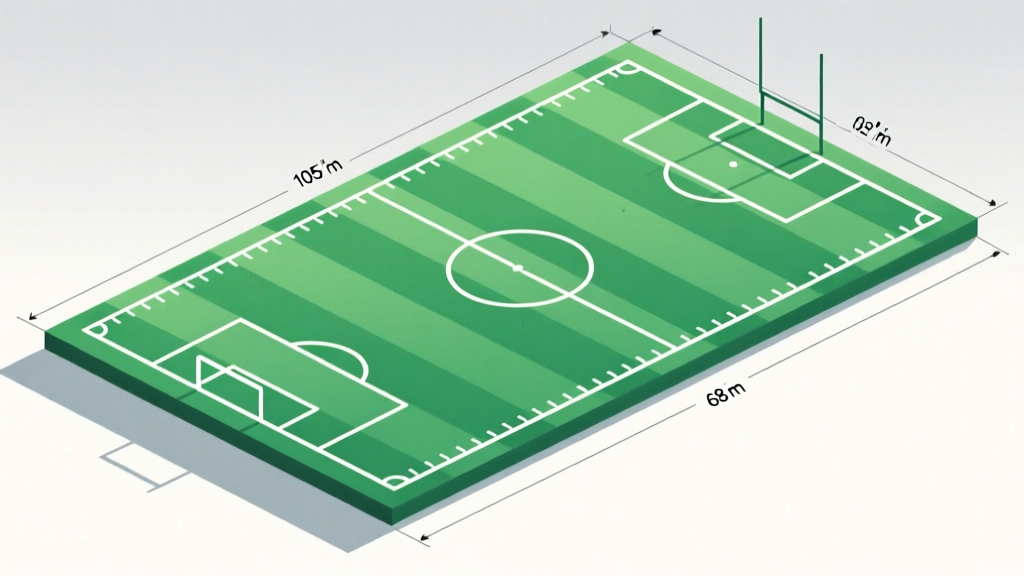
Drawing of a Football Field: Layout, Dimensions & Uses
Understanding a Drawing of a Football Field
A drawing of a football field visually represents the dimensions, markings, and layout of a regulation or modified American football playing surface. These diagrams are essential for coaches, players, and analysts to design plays, teach strategy, and understand spatial positioning during games. A standard NFL field measures 120 yards long (including two 10-yard end zones) and 53.3 yards wide, with consistent yard-line markings every 5 yards and hash marks guiding player alignment.
Key Components in a Football Field Drawing
When analyzing or creating a drawing of a football field, several critical elements must be accurately represented to reflect real-game conditions. These components ensure clarity for play design, officiating, and training purposes.
Essential Markings and Features
- Field Length and Width: Total length is 120 yards (360 feet), width is 53.3 yards (160 feet).
- End Zones: Each 10-yard deep area at both ends of the field where touchdowns are scored.
- Yard Lines: Marked every 5 yards across the field; numbers indicate distance from the goal line.
- Hash Marks: Narrower lines that determine where the ball is spotted; spacing varies by league (NFL, NCAA, high school).
- Sidelines and Goal Lines: Boundary lines defining playable area.
- Numbers and Logos: Team or league logos, field numbers (every 10 yards), and sponsor markings.
Differences Across Leagues in Field Drawings
While most football fields follow similar layouts, key variations exist between professional, college, and high school levels—especially in hash mark placement and field dimensions. Accurate drawings reflect these distinctions to support proper tactical planning.
| Feature | NFL | NCAA (College) | High School |
|---|---|---|---|
| Field Length (excluding end zones) | 100 yards | 100 yards | 100 yards |
| End Zone Depth | 10 yards | 10 yards | 10 yards |
| Field Width | 53.3 yards | 53.3 yards | 53.3 yards |
| Hash Mark Spacing (width) | 18.5 feet apart | 40 feet apart | 53.3 feet apart |
| Distance Between Yard Lines | 5 yards | 5 yards | 5 yards |
| Goal Post Width | 18.5 feet | 23.3 feet | 23.3 feet |
The table highlights how hash mark spacing narrows significantly from high school to the NFL, concentrating plays toward the center of the field in professional games. This impacts offensive strategy, particularly in sideline play and kicking alignment. Goal post width also decreases in the NFL, making field goals slightly more challenging despite shorter distances.
Uses of Football Field Diagrams in Sports
Detailed drawings of football fields serve multiple practical applications across coaching, education, broadcasting, and digital analytics platforms.
Common Applications
- Play Design: Coaches use field diagrams to sketch offensive and defensive formations.
- Player Education: Visual aids help athletes understand route running, coverage zones, and blocking schemes.
- Broadcast Graphics: TV networks overlay animated field drawings during live games to illustrate strategies.
- Video Analysis: Teams annotate game footage using digital field overlays to assess performance.
- Fantasy & Betting Tools: Analysts use field position data to predict scoring likelihood based on drive location.
Frequently Asked Questions About Football Field Drawings
What does a standard drawing of a football field include?
A standard drawing includes the full 120-yard length (with end zones), 53.3-yard width, yard lines every 5 yards, hash marks, goal lines, sidelines, and often team logos or numerical markers. It may also show bench areas and scoreboard positions depending on detail level.
How are hash marks different in NFL vs college football?
In the NFL, hash marks are 18.5 feet apart, while in college (NCAA) they are 40 feet apart, and in high school, they span the full width of the field at 53.3 feet. The narrower NFL spacing centralizes play and affects formation choices.
Why is a football field 120 yards long if the playing field is 100 yards?
The total length is 120 yards because it includes two 10-yard end zones in addition to the 100-yard playing field. While only 100 yards are used for gaining yardage, the full 120-yard measurement defines the complete field structure.
Can I create a football field drawing online?
Yes, several online tools like SmartDraw, VIZR, and XOS PlayBook allow users to create accurate football field diagrams. These platforms offer drag-and-drop features for players, routes, and formations tailored to NFL, NCAA, or high school specifications.
Are football field drawings to scale?
Professional and educational drawings are typically created to scale, especially when used for coaching or broadcasting. Digital tools automatically maintain correct proportions, while hand-drawn versions should follow official dimensions to remain accurate.
More Articles
 What Football Conference Is Oklahoma In? (2025 Update)
 Match Premium Football Gear With Beginners
 Houston Texans Game Time Today: Kickoff Schedule 2024
 MNF Announcers 2026: Full Broadcast Team
 What NFL Games Are On TV Tonight? Schedule & Channels
 Where Did Eli Manning Play College Football?
 How Long Is a Football Season? By League & Region
 Why Does New York Have Two Football Teams?
 Step and Safety: Football Equipment Analysis
 Texas A&M Football Schedule 2025: Dates, Times, and TV Info