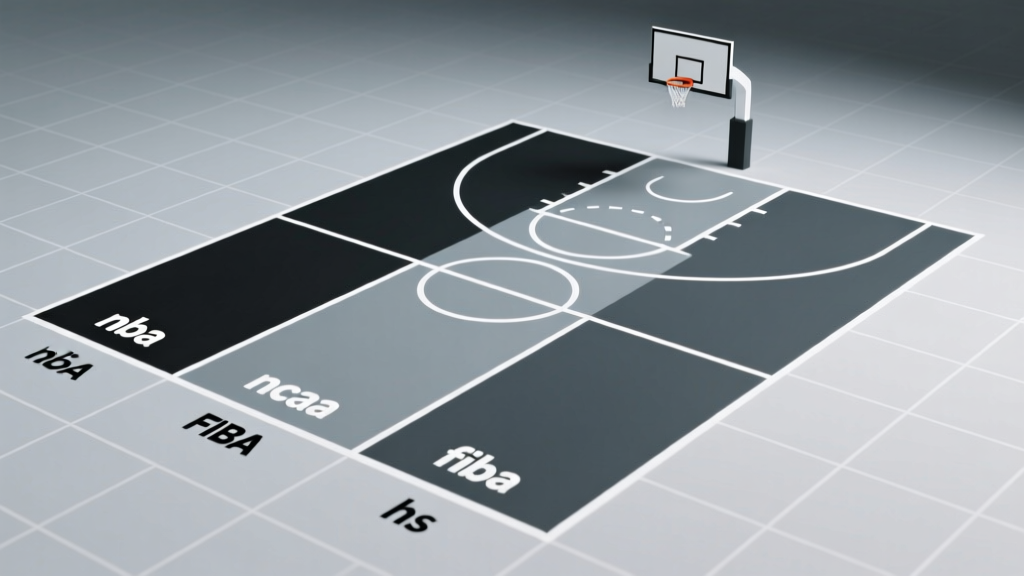
Basketball Court Size: NBA, NCAA, FIBA & HS Dimensions
A standard full-size basketball court is 94 feet long by 50 feet wide (28.65 m × 15.24 m) for professional and NCAA games, while high school courts are slightly smaller at 84 feet by 50 feet. International FIBA courts measure 28 meters by 15 meters (91.86 ft × 49.21 ft).
Understanding Basketball Court Dimensions
Basketball court size varies depending on the level of play and governing body. Whether you're designing a court, watching a game, or training as a player, knowing exact dimensions ensures proper gameplay and strategy execution. The length, width, key area, three-point line, and free-throw distance all impact performance and officiating.
Key Components of a Basketball Court
- Court length and width
- Free-throw line distance from the backboard
- Three-point arc radius
- Painted area (the "key" or "lane")
- Center circle diameter
- Backboard and rim height
NBA vs. NCAA vs. FIBA vs. High School Court Sizes
Different leagues follow different standards. While NBA and NCAA men's basketball share the same court size, FIBA and high school courts differ slightly in measurements, especially in the three-point line and key areas.
| League/Organization | Length | Width | Three-Point Distance (Corner) | Three-Point Distance (Straightaway) | Free-Throw Line to Backboard | Key (Lane) Width |
|---|---|---|---|---|---|---|
| NBA | 94 ft (28.65 m) | 50 ft (15.24 m) | 22 ft (6.70 m) | 23.75 ft (7.24 m) | 15 ft (4.57 m) | 16 ft (4.88 m) |
| NCAA Men | 94 ft (28.65 m) | 50 ft (15.24 m) | 21.65 ft (6.60 m) | 22.15 ft (6.75 m) | 15 ft (4.57 m) | 12 ft (3.66 m) |
| NCAA Women | 94 ft (28.65 m) | 50 ft (15.24 m) | 20.75 ft (6.32 m) | 22.15 ft (6.75 m) | 15 ft (4.57 m) | 12 ft (3.66 m) |
| FIBA | 28 m (91.86 ft) | 15 m (49.21 ft) | 21.65 ft (6.60 m) | 22.15 ft (6.75 m) | 15.09 ft (4.60 m) | 16.08 ft (4.90 m) |
| High School (NFHS) | 84 ft (25.60 m) | 50 ft (15.24 m) | 19.75 ft (6.02 m) | 19.75 ft (6.02 m) | 15 ft (4.57 m) | 12 ft (3.66 m) |
The data shows that while court length and width are largely consistent across elite levels, the three-point line varies significantly. The NBA has the deepest three-point line in straightaway position, contributing to strategic spacing. FIBA courts are slightly shorter and narrower, affecting transition speed and defensive coverage. High school courts are shorter in length, which impacts fast-break dynamics.
How Court Size Affects Gameplay
The physical dimensions of a basketball court directly influence player movement, spacing, and tactical decisions. Larger courts demand greater endurance and emphasize transition play, while smaller courts increase physical contact and compress offensive sets.
Impact on Player Performance
- Longer courts require superior cardiovascular fitness
- Wider lanes (like in the NBA) open driving lanes but reduce post-up space
- Deeper three-point lines reward elite shooters and influence shot selection
- Shorter high school courts favor aggressive man-to-man defense
Building or Marking a Basketball Court
When constructing a basketball court, precise measurements are essential for regulation compliance and safety. Use permanent markings for outdoor courts and tape or paint for indoor facilities.
Steps to Lay Out a Regulation Court
- Determine available space and intended use (recreational vs. competitive)
- Select the appropriate standard (NBA, FIBA, NCAA, or high school)
- Measure and mark center point and midcourt line
- Use string and chalk to outline sidelines, baselines, and key areas
- Mark free-throw line, three-point arc, and center circle using templates or trammel points
- Apply durable paint or tape
Common Questions About Basketball Court Size
What is the standard size of a professional basketball court?
The standard size of a professional basketball court, such as in the NBA, is 94 feet long by 50 feet wide (28.65 m × 15.24 m). This includes the playing area within the sidelines and baselines.
How big is a half-court basketball size?
A half-court basketball size is typically half of a full court. In the NBA, this measures 47 feet by 50 feet (14.33 m × 15.24 m). For high school, it’s 42 feet by 50 feet. Half-courts are common in recreational play and driveways.
Are FIBA court dimensions different from NBA?
Yes, FIBA courts are slightly smaller than NBA courts. FIBA regulations specify a court size of 28 meters by 15 meters (91.86 ft × 49.21 ft), compared to the NBA’s 94 ft × 50 ft. The three-point line and key area also differ in measurement.
How far is the three-point line in the NBA?
In the NBA, the three-point line is 23.75 feet (7.24 meters) from the basket at the top of the arc, and 22 feet (6.70 meters) in the corners. This creates a rounded arc that varies in distance depending on the shooting angle.
Why do high school basketball courts have a shorter three-point line?
High school basketball courts have a shorter three-point line (19.75 feet) because players are generally younger and less physically developed. A shorter distance encourages skill development without discouraging outside shooting due to excessive range.
More Articles
 How Much Do Basketball Players Make? 2025 Salaries Revealed
 Basketball Shooting Drills: 7 Exercises to Improve Your Jump Shot
 What Does Double Double Mean in Basketball?
 When Do Basketball Playoffs Start? 2025 NBA Schedule
 Best Baseball for Athletes: Performance, Safety, and Regulation Compliance Explained
 What Channel Is Michigan Basketball On Today?
 What Do Forwards Do in Basketball? Key Roles Explained
 How To Choose NCAA Basketball Shoes: A Performance-Driven Guide for Collegiate Athletes
 Watch Basketball Tonight: Live Streams & TV (2026)
 Who Is Playing Basketball Today? Top Players & Stats