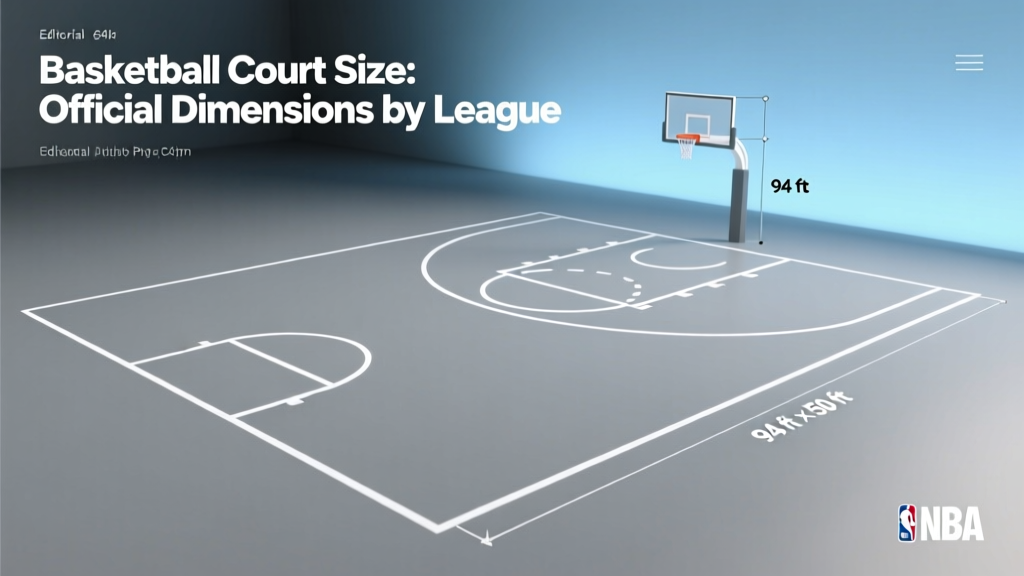
Basketball Court Size: Official Dimensions by League
A standard full-size basketball court measures 94 feet long by 50 feet wide (28.65 m × 15.24 m) for professional and NCAA games, while high school courts are slightly shorter at 84 feet by 50 feet. Key areas include the three-point line, free-throw lane, and rim height, which is universally set at 10 feet (3.05 m).
Understanding Basketball Court Dimensions
Basketball court size varies depending on the level of play—from NBA arenas to high school gyms. However, all official courts follow standardized measurements regulated by governing bodies like FIBA, NBA, NCAA, and NFHS. Knowing these dimensions is essential for players, coaches, architects, and sports facility planners.
Key Components of a Basketball Court
- Court Length and Width: Varies between leagues but typically 94 ft × 50 ft for pro levels.
- Rim Height: Always 10 feet (3.05 meters) above the ground across all levels.
- Three-Point Line Distance: Ranges from 22 ft (corner) to 23.75 ft (top of key) in NBA; shorter in NCAA and FIBA.
- Free-Throw Line: Located 15 feet from the backboard.
- Paint or Key Area: The rectangular zone beneath the basket, varying in width and shape by league.
NBA vs. NCAA vs. FIBA vs. High School Court Sizes
Different leagues adhere to different court specifications. While overall court length and width may be similar, critical zones such as the three-point arc and paint area differ significantly.
| League | Length (ft) | Width (ft) | Three-Point Distance (ft) | Paint Width (ft) | Rim Height (ft) |
|---|---|---|---|---|---|
| NBA | 94 | 50 | 23.75 (max), 22 (corners) | 16 | 10 |
| NCAA Men | 94 | 50 | 22.17 | 12 | 10 |
| NCAA Women | 94 | 50 | 20.75 | 12 | 10 |
| FIBA | 91.86 | 49.21 | 22.49 | 16.08 | 10 |
| High School (NFHS) | 84 | 50 | 19.75 | 12 | 10 |
The data shows that while NBA and NCAA courts share the same footprint, FIBA courts are slightly smaller in both length and width. The three-point line is shortest in U.S. high schools and longest at the top of the NBA arc. Notably, FIBA uses a trapezoidal key, whereas the NBA uses a rectangle. These differences impact spacing, shooting strategy, and defensive schemes.
Breakdown of Key Zones on a Basketball Court
Three-Point Line Variations
The distance from the basket to the three-point line directly affects shot difficulty and offensive strategy. In the NBA, the arc extends to 23.75 feet at the center but shortens to 22 feet in the corners, creating high-value scoring zones. FIBA and NCAA use a consistent radius, simplifying floor design.
The Paint (or Key)
The painted area under the basket governs post play and interior defense. The NBA's wider 16-foot key allows more space for big men, while NCAA and high school use a narrower 12-foot key, increasing congestion and physicality.
Free-Throw Line and Circle
The free-throw line sits 15 feet from the face of the backboard. The semi-circular free-throw circle, typically 6 feet in radius, marks where non-shooters must remain behind during attempts.
Smaller and Alternative Court Sizes
Not all basketball is played on full courts. Smaller formats exist for youth development, recreational play, and urban settings.
- Half-Court: Commonly used in pick-up games and training; measures 47 ft × 50 ft (NBA full court halved).
- Youth Courts: For ages 7–12, courts can range from 74 ft to 84 ft in length with adjusted three-point lines.
- Futsal or Outdoor Courts: Often 70 ft × 40 ft, especially in confined spaces.
- Portable or Modular Courts: Used for events or multi-sport facilities, often modular tiles measuring 94 ft × 50 ft when assembled.
Frequently Asked Questions About Basketball Court Size
How big is a professional basketball court?
A professional basketball court, such as in the NBA, is 94 feet long and 50 feet wide. This size is also used in NCAA men's basketball. The playing surface totals 4,700 square feet.
What is the size of a high school basketball court?
A high school basketball court, governed by NFHS rules, is 84 feet long and 50 feet wide. The three-point line is 19.75 feet from the basket, and the key is 12 feet wide.
How far is the three-point line in the NBA?
In the NBA, the three-point line ranges from 22 feet in the corners to 23 feet 9 inches (23.75 feet) at the top of the key. This creates strategic advantages for corner three-point attempts.
Is a college basketball court the same size as an NBA court?
Yes, NCAA men's basketball courts are the same size as NBA courts: 94 feet by 50 feet. However, the three-point line is closer at 22.17 feet, and the women's line is even shorter at 20.75 feet.
Why do FIBA courts differ from NBA courts?
FIBA courts are slightly smaller at 91.86 feet long and 49.21 feet wide. The three-point line is 22.49 feet, and the key is uniquely trapezoidal. These differences reflect international standards aimed at global consistency in competition.
More Articles
 Who Is the Best Basketball Player Ever in the NBA?
 How Many Points Are Scored in a College Basketball Game?
 What College Basketball Games Are On Tonight? Schedule & TV
 Most Popular Basketball Player in 2025: LeBron James
 What Channel Is Ohio State Basketball On Today?
 How Old Was Michael Jordan When He Retired?
 How Many Division I Basketball Teams Are There? (2025)
 How Many Fouls to Foul Out in College Basketball?
 How Many Steps Is a Travel in Basketball?
 What Does FT Mean in Basketball? Explained