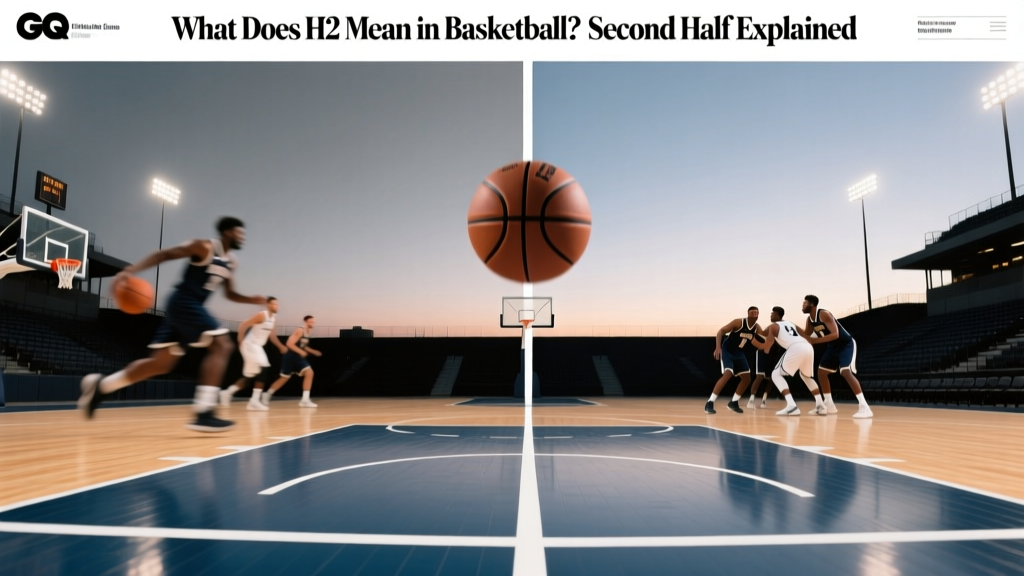
What Does H2 Mean in Basketball? Second Half Explained
In basketball, H2 refers to the second half of a game, marking the period after halftime when teams return to play the remaining two quarters (in NBA and FIBA) or the final two quarters in high school and college games. It is a critical phase where strategy, stamina, and adjustments made during halftime often determine the outcome.
Understanding H2 in Basketball: What Does It Stand For?
The term H2 stands for "Half 2," meaning the second half of a basketball game. After the first half (H1), which includes the first and second quarters, teams take a break during halftime before returning to play H2, consisting of the third and fourth quarters. This structure is standard across major leagues including the NBA, NCAA, and FIBA.
Why Is H2 Important?
- H2 is when coaches implement strategic adjustments based on H1 performance.
- Teams trailing at halftime use H2 to mount comebacks. \li>Player conditioning and mental focus are tested as fatigue sets in.
- Bench players often get increased minutes in H2 if starters are in foul trouble.
Structure of a Basketball Game: Quarters and Halves
Basketball games are divided into four quarters, grouped into two halves:
| League | Quarter Length | Total Game Time | H2 Duration |
|---|---|---|---|
| NBA | 12 minutes | 48 minutes | 24 minutes |
| NCAA Men | 20 minutes | 40 minutes | 20 minutes |
| NCAA Women | 10 minutes | 40 minutes | 20 minutes |
| FIBA | 10 minutes | 40 minutes | 20 minutes |
| High School | 8 minutes | 32 minutes | 16 minutes |
The table shows that while quarter lengths vary by league, all maintain a two-half format. H2 consistently represents half the total regulation time. The NBA has the longest H2 at 24 minutes, making endurance crucial for player performance in close games.
Key Differences Between H1 and H2
The shift from H1 to H2 involves more than just timing—it reflects evolving game dynamics.
Tactical Adjustments
Coaches analyze H1 stats and opponent tendencies during halftime, then adjust offensive sets, defensive schemes, and substitution patterns for H2. These changes can dramatically shift momentum.
Player Performance Trends
- Star players often increase scoring output in H2 when games are tight.
- Defensive intensity typically rises as teams protect leads or attempt comebacks.
- Foul accumulation impacts rotation decisions—players with 3+ fouls in H1 may be rested early in H2.
Real-Game Impact of H2 Performance
Historical data shows that team performance in H2 frequently determines victory, especially in competitive matchups.
| Season | Team | H2 Point Differential | Win % When Leading in H2 |
|---|---|---|---|
| 2023–24 | Denver Nuggets | +3.1 PPG | 94% |
| 2023–24 | Golden State Warriors | +1.8 PPG | 88% |
| 2023–24 | Dallas Mavericks | -0.9 PPG | 67% |
| 2022–23 | Milwaukee Bucks | +4.3 PPG | 96% |
| 2022–23 | Phoenix Suns | +2.7 PPG | 91% |
Teams with strong H2 point differentials tend to have higher win rates, indicating superior conditioning and coaching. The Milwaukee Bucks’ +4.3 PPG advantage in H2 during 2022–23 highlights their dominance in closing games. Conversely, teams like the Mavericks struggle to maintain leads, suggesting room for improvement in late-game execution.
Common Misunderstandings About H2
Some fans confuse H2 with overtime or think it refers to a player position or stat. However, H2 strictly denotes the second half of regulation play. It is not used in official scorekeeping but appears in broadcast graphics, analytics dashboards, and coaching reports to simplify communication.
Frequently Asked Questions About H2 in Basketball
What does H2 mean in basketball box scores?
H2 does not appear in official box scores but is used informally in analytics platforms and commentary to represent points, rebounds, or assists recorded during the second half.
Is H2 the same in NBA and college basketball?
Yes, H2 refers to the second half in both NBA and NCAA games. However, the duration differs—24 minutes in the NBA and 20 minutes in college due to shorter quarters.
Can a team comeback in H2 if they’re down by 20 points?
Yes, though rare, multiple NBA games have seen 20+ point comebacks in H2. The largest in NBA history is a 36-point deficit overcome by the Utah Jazz against the Denver Nuggets in 1996.
Do teams change strategies in H2?
Absolutely. Coaches use halftime to adjust defenses (e.g., switching to zone), fix offensive flow issues, and address foul trouble. These tactical shifts define H2 performance.
Does H2 include overtime?
No. H2 refers only to the second half of regulation time. Overtime periods are separate and labeled OT1, OT2, etc., and are not part of H2.
More Articles
 When Basketball Season Starts: NBA, NCAA & Global Leagues
 How Much Do Overseas Basketball Players Make? (2025 Data)
 Who Won the NCAA Basketball Tournament in 2008?
 What Channel Is NCAA Basketball On Tonight? (Oct 2025)
 Olympics Basketball Final 2024: Date and Time
 Next Warriors Game: Date, Time & How to Watch
 How Are Basketballs Made? Materials, Process & Science
 Basketball Foul Types and Penalties
 What Color Is a Basketball? Orange Explained
 Where Do the Duke Blue Devils Play Basketball?