How Was Basketball Invented? The True Story
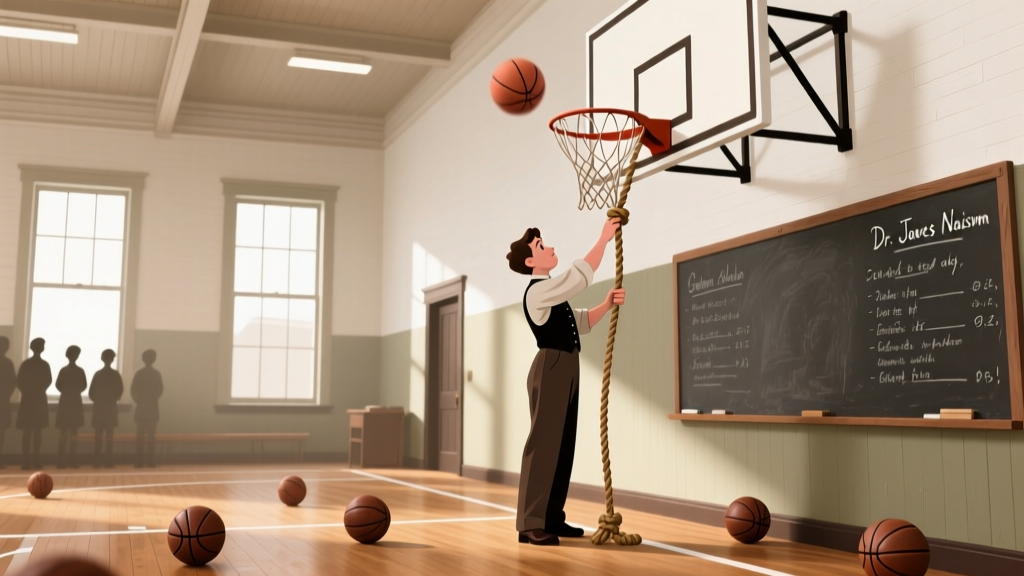
In December 1891, basketball was invented by Dr. James Naismith, a Canadian physical education instructor at Springfield College in Massachusetts, as a way to keep athletes active indoors during the winter months. Using a soccer ball and two peach baskets, he created a game with 13 original rules, laying the foundation for modern basketball.
The Origins of Basketball
Basketball was born out of necessity. In the winter of 1891, students at the International YMCA Training School in Springfield, Massachusetts, were restless due to limited indoor activities. Dr. Luther Gulick, head of the physical education department, tasked James Naismith with developing a new indoor game that was safe, easy to learn, and suitable for gymnasium play.
Why Was a New Game Needed?
- Winter weather made outdoor sports impractical
- Existing indoor games were too rough or unsuitable for confined spaces
- There was a need for a sport that emphasized skill over physical contact
- The goal was to maintain student fitness year-round
The Creation Process
Naismith sought a game that minimized physical contact while promoting teamwork and strategy. He analyzed existing sports and identified key principles: the ball should be moved by passing, not running; physical aggression should be discouraged; and scoring should require precision.
Key Steps in Inventing the Game
- Naismith reviewed various games like rugby, soccer, and lacrosse
- He concluded that using hands (not feet) and an elevated goal would reduce tackling
- He chose a soccer ball for its size and availability
- Peach baskets were nailed to a balcony 10 feet high—the origin of the standard hoop height
- He wrote 13 basic rules within a few days
The First Game and Early Development
The first official basketball game took place on December 21, 1891, with nine players per team. The final score was just 1–0, highlighting the game’s early focus on defense and difficulty in scoring. Despite the low pace, the game quickly gained popularity among students.
Early Rule Evolution
- Backboards were introduced in 1893 to prevent spectators from interfering
- The bottom of the baskets was removed in 1893 for easier ball retrieval
- Dribbling emerged organically and wasn't part of the original rules
- The number of players was standardized to five per team by 1895
- The shot clock wasn’t introduced until 1954, revolutionizing offensive play
James Naismith's Legacy
Dr. James Naismith not only invented basketball but also coached the University of Kansas basketball team, laying the groundwork for one of college basketball’s most storied programs. Though he never patented the game, his vision fostered a global phenomenon.
| Year | Event | Significance |
|---|---|---|
| 1891 | First game played in Springfield, MA | Birth of basketball with 13 original rules |
| 1893 | First women's game played at Smith College | Expansion of the sport to women |
| 1895 | Five-player teams standardized | Established modern team structure |
| 1936 | Basketball debuts in Olympics (Berlin) | Global recognition as an international sport |
| 1946 | BAA (precursor to NBA) founded | Laid foundation for professional league |
| 1949 | NBA formed after BAA-NBL merger | Establishment of premier professional league |
| 1954 | 24-second shot clock introduced | Dramatically increased scoring and pace |
The timeline shows how basketball evolved from a simple indoor activity to a fast-paced global sport. Key innovations like the shot clock and international competition accelerated its growth. The standardization of rules and team size in the early years laid the structural foundation still used today.
How Basketball Spread Worldwide
YMCA networks played a crucial role in spreading basketball across North America and beyond. By 1895, the game had reached Europe, Asia, and South America. FIBA (International Basketball Federation) was founded in 1932, further unifying international play and organizing world championships.
Frequently Asked Questions About How Basketball Was Invented
Who invented basketball and when?
Dr. James Naismith invented basketball in December 1891 while working at the International YMCA Training School in Springfield, Massachusetts.
Why was basketball invented?
Basketball was invented to provide a safe, engaging indoor activity for athletes during the harsh New England winters when outdoor sports were not feasible.
What were the original rules of basketball?
Naismith established 13 original rules, including no running with the ball, no physical contact, and scoring by throwing the ball into a peach basket. Players could only pass or bat the ball.
Why are basketball hoops 10 feet high?
The height of 10 feet comes from the first game, where Naismith nailed peach baskets to a balcony railing that was exactly 10 feet above the floor. This height was retained as the standard even after dedicated hoops were developed.
Was dribbling part of the original game?
No, dribbling was not included in Naismith’s original 13 rules. It developed later as players discovered they could bounce the ball to advance it, eventually becoming a fundamental skill in modern basketball.
More Articles
 Can Basketball Make You Taller? Science Explained
 How High Is an NBA Basketball Rim? 10 Feet Explained
 What Does Tenacity Mean in Basketball?
 What Channel Is Duke Basketball On Tonight? (2025)
 How Long Is an NBA Basketball Game? Full Breakdown
 Where Is the NBA Basketball Hall of Fame Located?
 How Many Teams Make the Big Ten Basketball Tournament?
 How Many Quarters in Basketball? Full Breakdown by League
 Who Is on Serbia Basketball Team? Current Roster 2025
 Next Duke Basketball Game: Date, Time, TV & Tickets