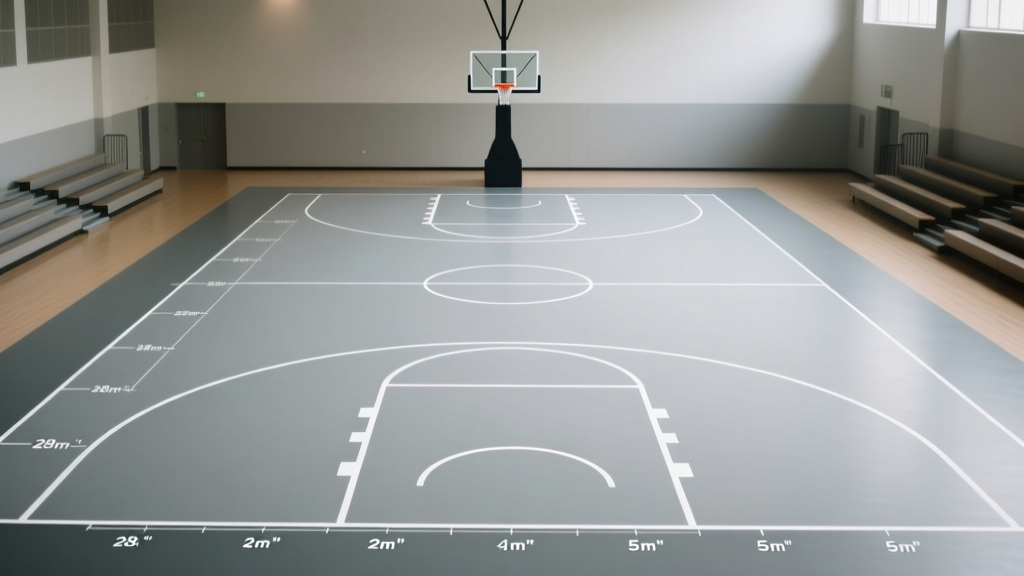
How Long Is a Basketball Court in Meters?
A standard full-size basketball court is 28 meters long and 15 meters wide, as defined by FIBA (International Basketball Federation) regulations. This size applies to professional and international competitions, including the Olympics and World Cup. The NBA court is slightly different at 28.65 meters in length, while high school and recreational courts may be shorter.
FIBA vs. NBA vs. College Court Dimensions
Basketball court sizes vary depending on the governing body and level of play. While FIBA sets the global standard, organizations like the NBA and NCAA have their own specifications. Understanding these differences is essential for players, coaches, and facility planners.
Key Differences Between Major Basketball Leagues
- FIBA courts are 28m x 15m (91.9 ft x 49.2 ft)
- NBA courts are 28.65m x 15.24m (94 ft x 50 ft)
- NCAA (college) courts follow NBA dimensions
- High school courts are typically 25.6m x 15.2m (84 ft x 50 ft)
- FIBA shortened the three-point line in 2010 to 6.75m from the arc
| Organization | Length (m) | Width (m) | Three-Point Line (m) | Key Area Width (m) |
|---|---|---|---|---|
| FIBA | 28.0 | 15.0 | 6.75 (6.60 at corners) | 4.9 |
| NBA | 28.65 | 15.24 | 7.24 (6.70 at corners) | 4.88 |
| NCAA Men | 28.65 | 15.24 | 6.75 | 4.88 |
| NCAA Women | 28.65 | 15.24 | 6.75 | 4.88 |
| High School (NFHS) | 25.60 | 15.20 | 6.25 | 4.88 |
The data shows that FIBA courts are slightly shorter and narrower than NBA and NCAA courts. The three-point line varies significantly, with the NBA having the deepest arc at 7.24 meters. High school courts are notably shorter, which impacts spacing and player development strategies.
Why Court Size Matters for Players and Coaches
The dimensions of a basketball court directly affect gameplay, strategy, and athlete performance. Larger courts require greater stamina and lateral movement, especially in transition defense and fast breaks.
Impact of Court Length on Game Dynamics
- Longer courts increase running distance per possession
- Spacing becomes more critical in half-court offense
- Defensive rotations take more time on larger surfaces
- Player endurance is tested more in NBA vs. FIBA games
- Coaching strategies adapt to available floor space
Basketball Court Markings and Key Zones
Beyond overall size, understanding key markings helps players and fans appreciate the game’s structure. These include the free-throw line, three-point arc, center circle, and restricted area.
Essential Court Features
- Free-throw line: 5.8 meters from the backboard (FIBA)
- Center circle diameter: 3.6 meters
- Restricted area arc: 1.25 meters radius around the basket
- Baseline and sideline boundaries define out-of-bounds
- Court surface must be flat, non-slip, and uniformly colored
Frequently Asked Questions About Basketball Court Length in Meters
How long is a professional basketball court in meters?
A professional basketball court under FIBA standards is 28 meters long. The NBA uses a slightly longer court at 28.65 meters (94 feet), which is also adopted by NCAA college basketball in the United States.
What is the width of a standard basketball court?
The standard width of a basketball court is 15 meters according to FIBA. The NBA and NCAA courts are slightly wider at 15.24 meters (50 feet), while high school courts are typically 15.2 meters wide.
Are Olympic basketball courts the same size as NBA courts?
No, Olympic basketball courts follow FIBA regulations and are 28 meters long and 15 meters wide, making them shorter than NBA courts, which are 28.65 meters long. The three-point line and key area also differ slightly between the two.
How long is a high school basketball court in meters?
A high school basketball court in the U.S. is typically 25.6 meters (84 feet) long and 15.2 meters (50 feet) wide, as regulated by the NFHS. This is shorter than both FIBA and NBA courts, affecting pace and spacing.
Does the three-point line distance vary by league?
Yes, the three-point line distance varies: FIBA uses 6.75 meters, the NBA has 7.24 meters at the top of the arc (6.70 at corners), and high school courts use 6.25 meters. These differences influence shooting strategy and player positioning.
More Articles
 Florida Gators vs Fayetteville State (2026)
 How Olympic Basketball Tournament Works
 What Does SF Mean in Basketball? Explained
 What Does GP Mean in Basketball? Explained
 How Many Teams Make the Big Ten Basketball Tournament?
 Syracuse Basketball Next Game: Schedule & Date (2026)
 When Does Team USA Basketball Play in 2025?
 Where to Watch Utah State vs Colorado State Basketball 2025
 Kentucky Basketball Game Time Today: What You Need to Know
 Who Was the First NBA Basketball Team?