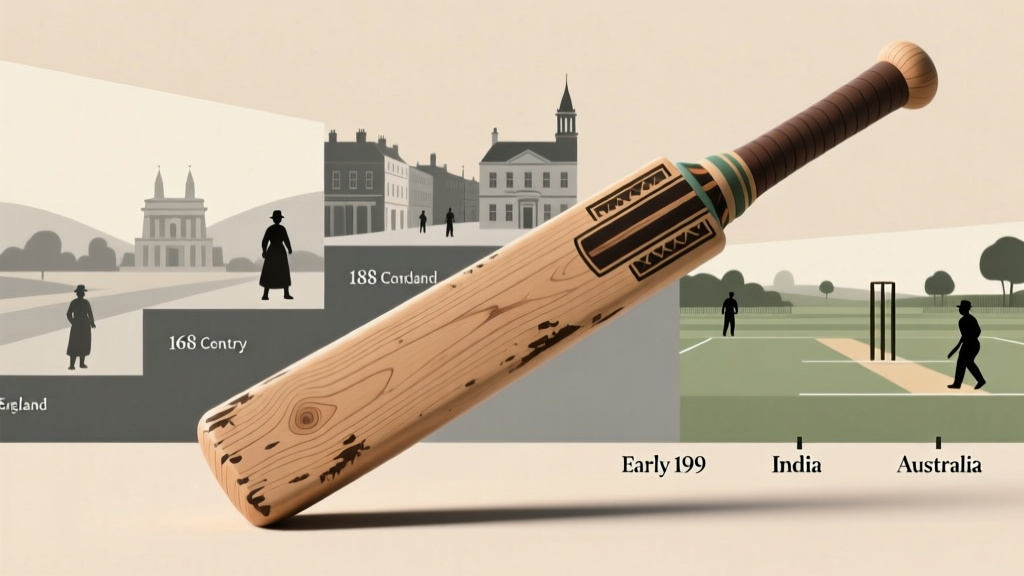
Where Did Cricket Originate? History & Evolution
Cricket originated in southeastern England during the 16th century, most likely as a children's game, and evolved into a structured sport by the 18th century with formal rules and organized matches.
The Historical Roots of Cricket
Cricket's origins trace back to early rural England, where it began as a simple pastime played by children in villages across Kent and Sussex. The game involved hitting a ball with a crude bat, often improvised from farm tools. By the 17th century, cricket had transitioned from a children's activity to an adult sport, gaining popularity among local communities.
Early Evidence of Cricket
- The first recorded mention of cricket dates to 1598, referencing a court case in Guildford, Surrey.
- By the 1620s, cricket was being played by adults, including parish teams and military units.
- The game spread rapidly through southern English counties due to favorable terrain and social structures.
Evolution of Cricket Rules and Structure
The standardization of cricket began in the 18th century, laying the foundation for modern gameplay. Key developments included codified laws, the establishment of clubs, and the growth of inter-county competition.
Milestones in Rule Development
- 1744: First known codification of Laws of Cricket by the London Cricket Club.
- 1787: Foundation of Marylebone Cricket Club (MCC), which later became the guardian of cricket laws. \li>1835: First official revision of the Laws by MCC, setting precedents still used today.
| Year | Event | Location | Significance |
|---|---|---|---|
| 1598 | First documented reference | Guildford, England | Court deposition mentions "creckett" as a boys' game. |
| 1709 | First recorded inter-county match | Sussex vs. Kent | Marked the beginning of organized competitive cricket. |
| 1744 | First written Laws of Cricket | London | Defined pitch length, stumps, and ball weight. |
| 1787 | Founding of MCC | Lord's Cricket Ground, London | Became the sport’s governing authority. |
| 1877 | First Test match | MCG, Melbourne, Australia | England vs. Australia; start of international cricket. |
The data illustrates how cricket evolved from informal village games to internationally recognized competition within less than three centuries. The institutional role of the MCC and the geographic expansion beyond England were pivotal in shaping modern cricket.
Global Spread and Modern Influence
British colonialism played a crucial role in spreading cricket across continents. Countries such as India, Australia, South Africa, and the West Indies adopted the sport, eventually becoming powerhouses in international cricket.
Key Factors in Global Expansion
- Colonial administration introduced cricket to local elites as a symbol of British culture.
- Establishment of domestic leagues and national teams in former colonies.
- Adoption and adaptation of the sport, leading to diverse playing styles and fan cultures.
Frequently Asked Questions About Cricket Origins
Where did cricket originate?
Cricket originated in southeastern England during the 16th century, most likely in the counties of Kent or Sussex, evolving from a children's field game into a formalized sport by the 18th century.
Who invented cricket?
No single person invented cricket. It developed organically in rural England, with early versions played by children. The modern form was shaped collectively through club play and formal rule-making, notably by the Marylebone Cricket Club (MCC).
When was the first cricket match played?
The first recorded cricket match took place in 1709 between teams from Sussex and Kent. However, informal games likely occurred over a century earlier, with the earliest documentary evidence dating to 1598.
Why is England considered the birthplace of cricket?
England is considered the birthplace because all early records, rule development, and institutional foundations—such as the MCC and Lord's Cricket Ground—are rooted in English history and society.
How did cricket spread around the world?
Cricket spread globally through British colonial influence in the 18th and 19th centuries. It was introduced to regions like the Indian subcontinent, the Caribbean, Southern Africa, and Australasia, where it gained lasting popularity and competitive structure.
More Articles
 How Many Super Bowls Has Peyton Manning Won? (Answer)
 Who Is the Number One Tennis Player in the World Today?
 Has Jalen Hurts Won a Super Bowl? Full Breakdown
 What Quarter Is the Super Bowl In Right Now?
 Which Boxer Has Been Knocked Out the Most?
 What Channel Is the Rose Bowl Parade On in 2026?
 Biggest MLB Baseball Stadium by Capacity
 Why Do Baseball Players Eat Sunflower Seeds?
 Where to Buy Golf Balls Near Me Today
 Where to Buy Golf Balls: Best Online & In-Store Options