Where Did Bowling Originate? Ancient Roots Revealed
Bowling originated in ancient Egypt, with evidence suggesting that a form of the game was played over 5,000 years ago, although modern bowling evolved primarily in Germany and England before becoming popular in the United States.
History of Bowling: From Ancient Origins to Modern Sport
Bowling is one of the oldest known recreational activities, with roots stretching back thousands of years. While the modern version of the sport developed in Europe, archaeological discoveries point to early forms of bowling in ancient civilizations.
Ancient Beginnings in Egypt
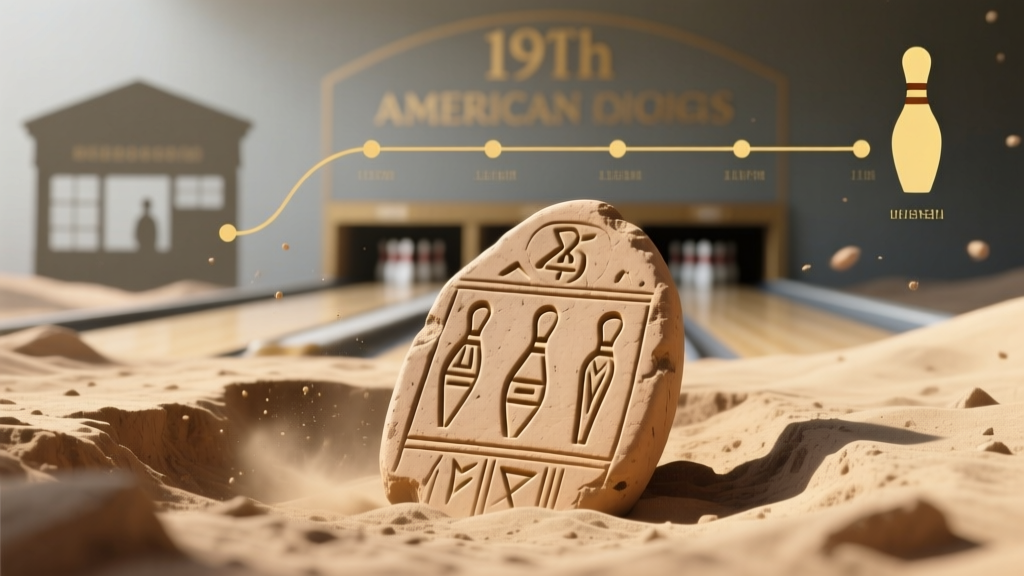
In 1930, British archaeologist Sir Flinders Petrie unearthed artifacts in an Egyptian child's grave dating back to around 3200 BCE. These included stone balls and pins, resembling a primitive bowling setup. This discovery is widely regarded as the earliest evidence of bowling-like activity.
- Stone balls were found alongside miniature pins made of limestone.
- The arrangement suggested a game involving rolling objects to knock down targets.
- This early version likely had religious or ceremonial significance.
Evolution in Germany and Medieval Europe
Bowling took on new forms during the Middle Ages, particularly in Germany, where it became associated with religious practices. A game called "Kegeln" was played by monks as part of a penitence ritual.
Over time, Kegeln spread across Europe. By the 14th century, variations appeared in England, often played outdoors on grassy lanes. These games laid the foundation for both skittles and lawn bowling (also known as bocce in some regions).
Rise of Modern Bowling
The transition from outdoor folk games to standardized indoor bowling occurred mainly in the 19th century, driven by German immigrants in the United States.
Standardization and Popularization in America
In 1875, the National Bowling Association was formed in New York, marking the beginning of organized competitive bowling. The American Bowling Congress (ABC) was established in 1895 to standardize rules, equipment, and lane dimensions.
- First official rulebook published by ABC in 1905.
- Introduction of automatic pinsetters in the 1950s revolutionized gameplay.
- Bowling alleys became social hubs during the 20th century.
Global Spread and Variants
While ten-pin bowling dominates in North America, other variants are popular worldwide:
- Nine-pin bowling: Common in Europe; banned temporarily in parts of the U.S. due to gambling concerns.
- Five-pin bowling: Developed in Canada; uses smaller balls without finger holes.
- Candlepin bowling: Played in New England; features tall, narrow pins and cylindrical balls.
- Duckpin bowling: Similar to candlepin but with shorter, squat pins.
| Variation | Country of Origin | Pins Used | Ball Weight (lbs) | Year Standardized |
|---|---|---|---|---|
| Ten-pin | United States | 10 | 6–16 | 1895 |
| Nine-pin | Germany | 9 | 3–6 | 1840s |
| Five-pin | Canada | 5 | 3.5 | 1909 |
| Candlepin | United States (New England) | 10 | 2.8 | 1946 |
| Duckpin | United States (Maryland) | 10 | 3–5 | 1927 |
The table highlights key differences among major bowling variants, showing how regional preferences shaped equipment and rules. Ten-pin bowling remains the most widely recognized internationally, especially after efforts to include it in the Olympic Games. The lighter balls used in candlepin and duckpin reflect their focus on precision rather than power.
Where Bowling Originated: Key Takeaways
Although modern bowling was formalized in the U.S., its origins trace back to ancient Egypt. Over centuries, the game evolved through European traditions like Kegeln before being standardized into the global sport we know today. Cultural adaptations have produced multiple variations, each preserving the core objective: knocking down pins using a rolling ball.
Frequently Asked Questions About Bowling Origins
Did bowling originate in Germany?
While modern bowling did not originate solely in Germany, a significant precursor called "Kegeln" was played there as early as the 3rd century. German monks rolled stones at pins as part of religious rituals, which later influenced European and American versions of the game.
Is there proof that bowling started in ancient Egypt?
Yes—archaeologist Sir Flinders Petrie discovered a set of stone balls and pins in an Egyptian tomb dating to 3200 BCE. These findings, housed in a museum in Berlin, are considered the oldest physical evidence of a bowling-like game.
How did bowling become popular in the United States?
Bowling gained popularity in the U.S. through German immigrants who introduced Kegeln in the 1800s. The formation of the American Bowling Congress in 1895 standardized rules, and post-WWII economic growth led to widespread construction of bowling alleys, making it a mainstream leisure activity.
Was bowling ever banned in the U.S.?
Yes—several states banned nine-pin bowling in the 19th century due to associations with gambling and disorderly conduct. Players circumvented the ban by adding a tenth pin, leading to the creation of ten-pin bowling, which eventually became the dominant version.
What is the oldest known bowling alley?
The oldest known indoor bowling alley was built in New York City in 1840 by Michael Phelan, an Irish immigrant. He later became a prominent figure in organizing competitive billiards and bowling events in the U.S.
More Articles
 College Baseball Game Length: Average Duration (2026)
 Will Tiger Woods Retire from Golf? Latest Update 2025
 Who Is the Greatest Tennis Player of All Time?
 How Many Karate Kid Movies Are There? Full List & Timeline
 Arm Wrestling Muscles: Key Muscles Used (2026)
 Tallest Baseball Player in MLB History | Jon Rauch
 Who Is the Greatest Baseball Pitcher of All Time?
 A-10 Baseball Standings 2025: Final Rankings & NCAA Outlook
 What Does Non-Tender Mean in Baseball? Explained
 When Was the First Super Bowl? Facts & History