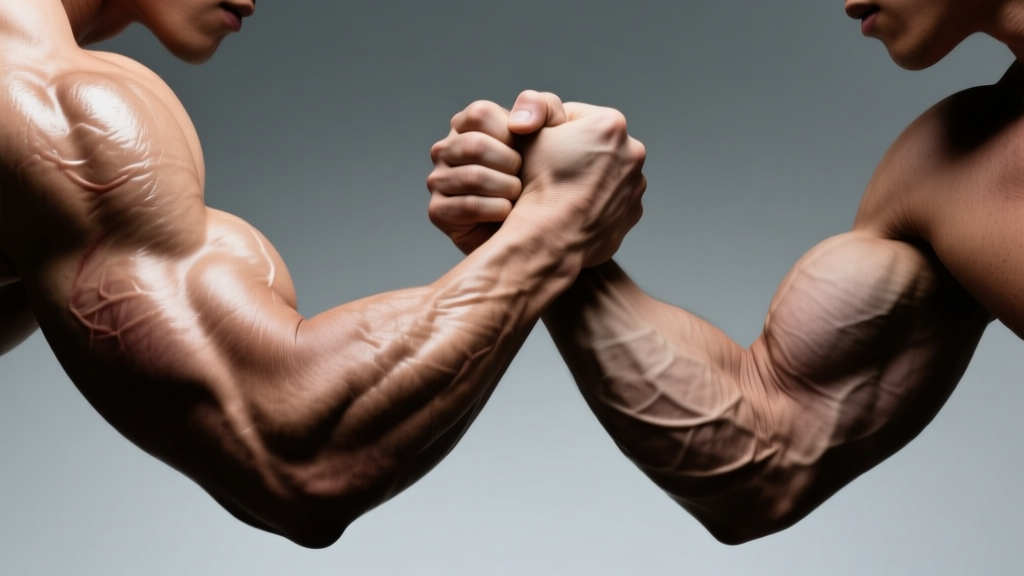
What Muscles Do You Use in Arm Wrestling?
Arm wrestling primarily engages the forearm flexors, biceps brachii, pronator teres, and flexor carpi radialis, with significant contributions from the pectoralis major, anterior deltoid, and finger flexors for stabilization and force generation.
Muscles Used in Arm Wrestling: A Comprehensive Breakdown
Arm wrestling is a highly specialized upper-body sport that demands explosive strength, precise technique, and muscular endurance. While it may appear to be a simple test of arm strength, it actually involves a complex synergy of multiple muscle groups working in coordination to generate maximal isometric and dynamic force.
Primary Muscles Activated During Arm Wrestling
The following muscles are directly responsible for generating the pulling, pushing, and rotational forces required to overpower an opponent:
- Flexor digitorum superficialis and profundus: Control grip strength and finger flexion, essential for maintaining control of the opponent's hand.
- Flexor carpi radialis and ulnaris: Stabilize the wrist and prevent buckling under pressure.
- Pronator teres and quadratus: Critical for internal rotation of the forearm, enabling the downward press motion.
- Biceps brachii: Provides elbow flexion and supination resistance, especially during top-roll techniques.
- Brachioradialis: Assists in elbow flexion, particularly in neutral or semi-pronated positions.
Secondary Supporting Muscles
While not directly involved in hand movement, these muscles provide stability, posture control, and additional power transfer:
- Pectoralis major (clavicular head): Engages during forward pressing motions, contributing to shoulder drive.
- Anterior deltoid: Assists in forward shoulder projection and force transmission.
- Latissimus dorsi: Helps stabilize the torso and anchor the body against the pinning table.
- Triceps brachii: Acts as a stabilizer to resist elbow extension when defending against a press.
- Core muscles (rectus abdominis, obliques): Maintain body alignment and prevent lateral shifting.
Biomechanics of Force Generation in Competitive Arm Wrestling
Successful arm wrestlers optimize leverage by combining wrist positioning, shoulder alignment, and hip drive. The initial 'hook' technique relies heavily on forearm flexors and pronators, while the 'top roll' emphasizes biceps and radial deviation. Electromyography (EMG) studies show peak activation in the flexor carpi radialis can exceed 85% of maximum voluntary contraction (MVC) during maximal efforts.
| Muscle Group | Peak EMG Activity (% MVC) | Role in Arm Wrestling |
|---|---|---|
| Flexor Carpi Radialis | 87% | Wrist stabilization, radial deviation |
| Pronator Teres | 92% | Forearm pronation, downward torque |
| Biceps Brachii | 76% | Elbow flexion, supination resistance |
| Pectoralis Major | 68% | Shoulder drive, forward pressure |
| Finger Flexors | 95% | Grip strength, hand control |
The data reveals that finger flexors and pronator teres exhibit the highest neuromuscular demand, confirming their critical role in match outcomes. Training programs should prioritize isometric endurance and explosive concentric contractions in these muscles. The high activation of wrist stabilizers underscores the importance of injury prevention strategies targeting the radioulnar and wrist joints.
Frequently Asked Questions About Arm Wrestling Muscles
What are the main muscles used in arm wrestling?
The primary muscles include the flexor carpi radialis, pronator teres, biceps brachii, and finger flexors. These muscles work together to generate grip strength, wrist stability, and forearm rotation necessary to overpower an opponent.
Does arm wrestling build biceps?
Yes, arm wrestling can contribute to biceps development, particularly through eccentric loading and isometric holds. However, dedicated resistance training with progressive overload is more effective for hypertrophy than arm wrestling alone.
Can arm wrestling cause muscle imbalances?
Yes, repetitive unilateral training without balanced antagonist work (e.g., extensors and supinators) can lead to muscle imbalances. This increases the risk of tendonitis, elbow pain, and reduced joint mobility over time.
How do you train your forearms for arm wrestling?
Effective training includes fingertip grip exercises, wrist rollers, reverse curls, pronation/supination drills with resistance bands, and static holds like towel hangs. Isometric training at various joint angles mimics real match conditions best.
Is arm wrestling more about technique or strength?
It's a combination of both. While raw strength provides a foundation, elite competitors rely on refined technique—such as timing, wrist positioning, and body leverage—to defeat stronger opponents. Proper technique also reduces injury risk during matches.
More Articles
 Who Won Super Bowl 2001? Ravens Beat Giants 34-7
 Where Can I Sell My Golf Clubs? Top 7 Options in 2025
 How Old Is Carlos Alcaraz? Age & Career Stats (2025)
 How Long Are Tennis Matches? Duration by Format & Event
 When Is Tennis Season? Pro & Amateur Schedule Explained
 Who Can Score Points in Badminton: Full Guide
 Olympic Archery Distance: 70 Meters Explained
 What Date Is the Super Bowl in 2026?
 How Many Super Bowls Have the Oakland Raiders Won?
 Who Is the Heavyweight Boxing Champion in 2025?