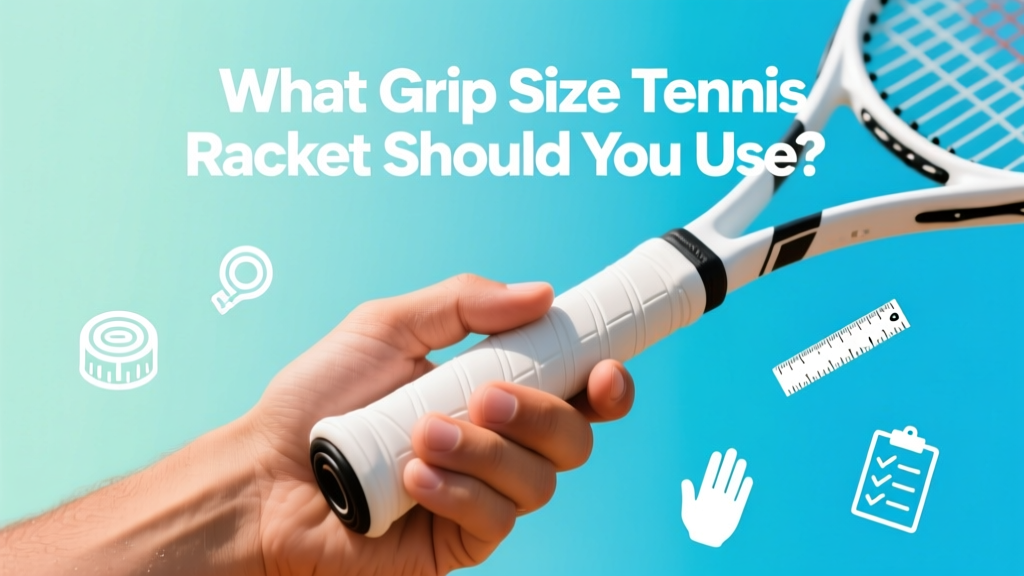
What Grip Size Tennis Racket Should You Use?
Choosing the correct grip size for your tennis racket is essential for performance, comfort, and injury prevention. The right grip size ensures better control, reduces the risk of tennis elbow, and enhances shot accuracy. Most adult players use grip sizes between 4¼" (108 mm) and 4⅜" (114 mm), with 4⅜" being the most common. To find your ideal size, measure from the tip of your ring finger to the middle crease of your palm—this length in inches corresponds to your ideal grip size in inches.
Why Grip Size Matters in Tennis
Selecting the proper grip size directly affects your playing style, comfort, and long-term joint health. A grip that's too large or too small can compromise your ability to execute key strokes like serves, volleys, and groundstrokes effectively.
Consequences of Incorrect Grip Size
- Grip too small: Forces fingers to wrap tightly, increasing forearm strain and risk of overuse injuries like tennis elbow.
- Grip too large: Limits wrist mobility and hinders quick grip changes, reducing racquet control and spin generation. \li>Poor shot consistency: Inadequate grip fit leads to compensatory movements, affecting timing and ball placement.
- Blisters and discomfort: Excessive hand movement within the grip causes friction and pain during prolonged play.
How to Measure Your Tennis Racket Grip Size
The most accurate way to determine your grip size is the finger-to-crease method. Follow these steps:
- Extend your dominant hand forward with fingers together.
- Place a ruler at the middle crease of your palm (the horizontal line closest to your wrist).
- Measure from this crease to the tip of your ring finger.
- The measurement in inches corresponds directly to the grip size in inches.
For example, if your measurement is 4⅜", your ideal grip size is 4⅜" (also labeled as L4).
Alternative Method: The On-Racket Test
If you're at a store or testing a racket:
- Hold the racket in a standard eastern forehand grip.
- Try to fit your index finger of your non-dominant hand into the space between your fingertips and palm.
- If it fits snugly, the size is correct. If it’s too tight or too loose, adjust accordingly.
Standard Tennis Grip Sizes by Brand
All major brands—Wilson, Babolat, Head, Yonex, Prince—follow the same grip sizing standards measured in inches. However, grip shapes may vary slightly between brands, so always test if possible.
| Grip Size (inches) | Grip Size (mm) | Label | Recommended Hand Length | Common For |
|---|---|---|---|---|
| 4" | 102 | L0 | 3⅞" – 4" | Youth, small-handed juniors |
| 4¼" | 108 | L1 | 4¼" | Women, small-handed adults |
| 4⅛" | 110 | L2 | 4⅛" | Average-sized hands |
| 4⅜" | 114 | L3 | 4⅜" | Most adult male players |
| 4¾" | 120 | L4 | 4¾" | Large-handed players |
| 4⅞" | 124 | L5 | 4⅞"+ | Rare, custom orders only |
The data shows that grip sizes are standardized across manufacturers, but hand dimensions vary widely. Over 60% of adult recreational players use L3 (4⅜") grips, yet many unknowingly play with undersized grips due to lack of awareness. Using an incorrect grip size even by 1\/8" can significantly increase forearm muscle activation, raising injury risk.
Adjusting Grip Size After Purchase
If your racket’s grip is slightly too small or too large, adjustments are possible without replacing the entire racket.
Using Overgrips and Grip Sleeves
- Overgrips: Add 1\/16" (1.5–2 mm) per layer. Two wraps can increase size by up to 1\/8".
- Grip sleeves (build-up sleeves): Installed under the existing grip, they add 1\/8" or more permanently.
- Removing layers: If the grip is too large, the original grip can be replaced with a thinner model.
Note: Adding more than two overgrips is not recommended, as it alters the shape and feel of the handle.
Player Profiles and Recommended Grip Sizes
Different player types often align with specific grip sizes based on hand size and playing style.
- Junior players: Typically start with 4" (L0) to 4⅛" (L2) depending on age and hand growth.
- Female players: Often use 4¼" (L1) or 4⅛" (L2); some prefer L3.
- Male players: Majority use 4⅜" (L3); larger-handed players opt for 4¾" (L4).
- Professional players: Vary widely—Novak Djokovic uses 4⅜", Rafael Nadal uses 4¾", Roger Federer used 4⅜".
Frequently Asked Questions About Tennis Racket Grip Size
What happens if my tennis grip is too small?
A grip that's too small forces your hand to clamp down excessively during swings, increasing forearm muscle fatigue and the risk of developing tennis elbow. It also reduces power transfer and makes it harder to maintain consistent racket face control.
Can I change the grip size of my current racket?
Yes, you can increase grip size using overgrips or build-up sleeves. Each overgrip adds about 1\/16" to the circumference. To decrease size, the existing grip can be removed and replaced with a thinner one by a professional stringer.
What grip size do most professional tennis players use?
Most pros use 4⅜" (L3), though variations exist. Rafael Nadal uses a larger 4¾" (L4), while Novak Djokovic and Roger Federer used 4⅜". Their choices reflect personal preference, hand size, and injury management strategies.
How often should I replace my overgrip?
Replace overgrips every 6–8 hours of play or when they become slippery or worn. Frequent replacement maintains optimal tackiness and sweat absorption, ensuring consistent grip feel and preventing slippage during matches.
Does grip size affect spin and serve performance?
Yes. A properly sized grip allows for efficient wrist snap and pronation during serves and topspin strokes. A grip that’s too large restricts wrist movement, reducing racquet head speed and spin potential, while a too-small grip can lead to inconsistent contact points.
More Articles
 Who Invented Billiards? Origins and Evolution Explained
 When Is the PGA Golf Tournament? 2025 Dates & Info
 Teams That Have Never Won the Super Bowl
 How Many Points to Win a Volleyball Match?
 Where Is The American Express Golf Tournament Held?
 How Long Are Wrestling Matches? By Level & Style
 How Long Is Each Inning in Baseball? Time Explained
 Most Super Bowl Wins by a Player: Tom Brady's Record
 How Old Is Andy Murray the Tennis Player? (2025 Update)
 How Much Does a Boxing Referee Get Paid?