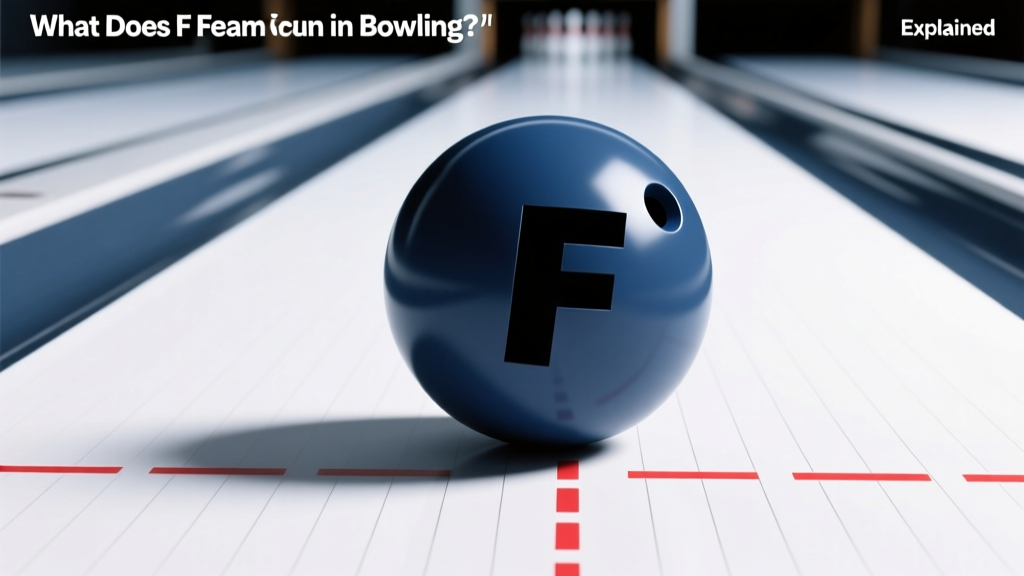
What Does F Mean in Bowling? Foul Explained
In bowling, the letter 'F' on a scoresheet stands for foul, indicating that a player stepped over or touched the foul line during their delivery. This results in no score being recorded for that shot, regardless of how many pins were knocked down.
Understanding the Meaning of 'F' in Bowling
The 'F' symbol is used in both manual and electronic scoring systems to mark a foul violation. A foul occurs when any part of the bowler's body crosses the foul line at the end of the approach while delivering the ball. Even if pins are knocked down after a foul, the roll counts as zero for that frame.
Fouls do not count as misses unless they occur during an attempt to pick up a spare. For example, if a bowler fouls on their second shot but had already knocked down some pins on the first shot, they still get credit for the pins from the first roll.
Common Causes of Fouls in Bowling
- Stepping on or over the foul line during release
- Slipping forward due to lack of traction
- Poor footwork or inconsistent approach
- Overaggressive follow-through
- Lack of awareness of lane positioning
How Fouls Impact Scoring
A foul affects scoring differently depending on when it happens:
- If a foul occurs on the first ball of a frame, all pins knocked down are reset, and the next roll starts with a fresh set of 10 pins.
- If a foul happens on the second roll (e.g., trying to pick up a spare), the pins knocked down by the foul shot do not count, but previously fallen pins remain down.
- In the tenth frame, a foul on a bonus roll still disqualifies that roll's score.
Detection and Enforcement of Fouls
Fouls can be detected manually or electronically:
- Manual Detection: Umpires or fellow players watch for foot placement at the line.
- Electronic Sensors: Many modern lanes have automatic foul detection systems using light beams or pressure sensors embedded along the foul line.
When a sensor detects contact past the line, it triggers a buzzer or visual signal and automatically logs an 'F' on the scoreboard.
Are All Touches Considered Fouls?
No. Only contact made during the delivery counts as a foul. Bowlers may legally touch the foul line after completing their shot, as long as no part of the foot broke the plane during release. However, repeated borderline actions may still be flagged by officials.
| Tournament Level | Average Fouls Per Game | Foul Detection Method | Penalty Applied |
|---|---|---|---|
| Recreational Leagues | 1.2 | Visual/Judge | Zero on roll |
| USBC Open Championships | 0.4 | Sensor + Review | Zero on roll |
| PBA Tour Events | 0.3 | Sensor + Video | Zero on roll |
| Youth Bowling Programs | 2.1 | Coach Observation | Warning + Zero |
| Senior Leagues (55+) | 1.6 | Self-Reported / Visual | Zero on roll |
The data shows that higher competition levels have fewer fouls due to stricter technique and better equipment. Electronic detection reduces human error and increases consistency across games. Youth programs show the highest foul rates, reflecting developing skills and physical coordination.
Strategies to Avoid Fouls
Minimizing fouls improves consistency and maximizes scoring potential. Here are effective techniques:
Footwear Maintenance
Use clean, well-maintained bowling shoes. Worn soles or dirty slides reduce control and increase slip risk.
Consistent Approach Drills
Practice your approach regularly to build muscle memory. Focus on finishing with your sliding foot just before the foul line.
Video Analysis
Record your delivery from the side to check foot position at release. Many bowlers discover they creep over the line only through video review.
Mental Cues
Use verbal or mental triggers like “toe behind the line” to reinforce proper form during play.
Common Questions About 'F' in Bowling
What does F mean in bowling scoring?
The 'F' stands for foul, meaning the bowler crossed the foul line during delivery. The shot is scored as zero, even if pins were knocked down.
Does a foul count as a throw in bowling?
Yes, a foul counts as a legal attempt and uses up one of the two shots per frame (or three in the 10th). However, no points are awarded for that roll.
Can you bowl a perfect game with a foul?
No. A perfect 300 game requires 12 consecutive strikes without any fouls, misses, or open frames. One foul invalidates the chance at a perfect score.
Is a foul always detected automatically?
No. Not all bowling centers have electronic foul sensors. In recreational play, fouls are often self-reported or called by opponents, relying on honor systems.
Do professional bowlers ever get fouls?
Yes, even professionals occasionally commit fouls—especially under fatigue or stress. However, PBA players average less than 0.5 fouls per game due to refined technique and training.
More Articles
 Teams in Last 5 Super Bowls: Full List & Results
 Watch MMA in 2026: Best Streaming Services & Channels
 Who Won the 2013 World Series? Red Sox Beat Cardinals
 Ole Miss Baseball Play Time Today: Game Schedule & Details
 Where Was Rugby Invented? The True Origin Story
 How Old Is Adam Scott the Golfer? (2025 Update)
 What's in the Box That Olympians Get?
 Super Bowl MVP: Winners, History & Voting Process
 How Many Super Bowls Have the Dallas Cowboys Won?
 Where to Watch LSU Baseball Today: Live Stream & TV Guide