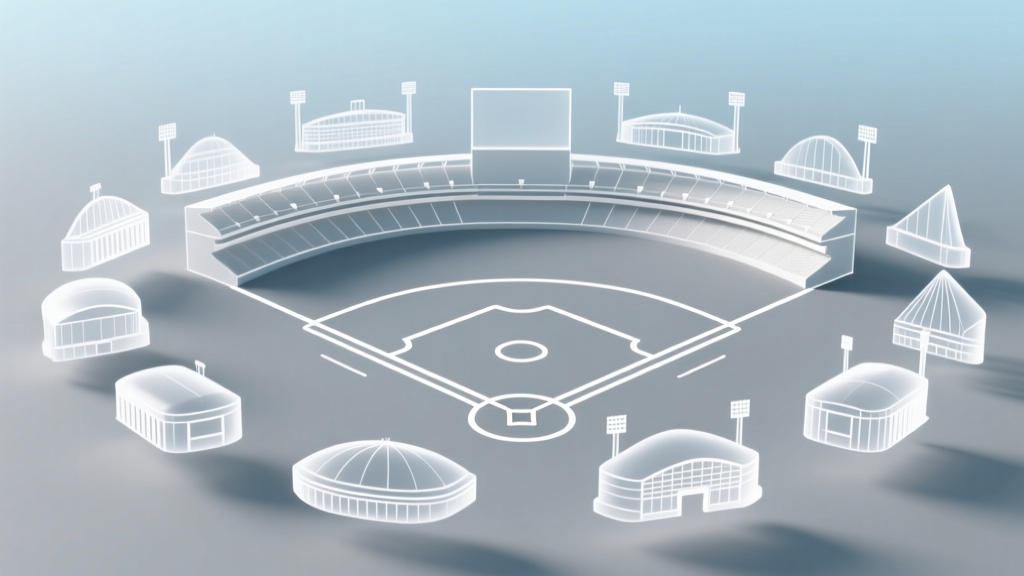
MLB Stadiums: All 30 Ballparks (2026)
There are 30 Major League Baseball (MLB) stadiums in the United States, one for each of the league's teams. These venues range from historic ballparks like Wrigley Field to modern facilities such as Globe Life Field, reflecting a blend of tradition and innovation in baseball culture.
Understanding MLB Stadiums: A Comprehensive Overview
Major League Baseball consists of 30 teams split evenly between the American League (AL) and National League (NL), each calling a unique stadium home. These stadiums serve not only as game-day arenas but also as cultural landmarks and economic drivers in their communities. With capacities ranging from approximately 30,000 to over 56,000, these ballparks offer diverse fan experiences shaped by architecture, location, and team history.
Key Facts About MLB Stadiums
- Each MLB team has one primary home stadium.
- No two MLB stadiums are identical in design or dimensions. \li>Stadiums vary significantly in age, with some over 100 years old.
- Newer stadiums often include mixed-use developments and advanced amenities.
- All current stadiums meet MLB safety, size, and field standards.
Breakdown of Stadiums by League and Region
MLB divides its 30 teams into six divisions—three in each league. This structure influences scheduling and playoff qualification, while also shaping regional rivalries reflected in ballpark attendance and atmosphere.
American League Ballparks
- AL East: Yankee Stadium (NYY), Fenway Park (BOS), Rogers Centre (TOR), Oriole Park at Camden Yards (BAL), Tropicana Field (TB)
- AL Central: Guaranteed Rate Field (CWS), Progressive Field (CLE), Comerica Park (DET), Target Field (MINN), Kauffman Stadium (KC)
- AL West: Angel Stadium (LAA), Oakland Coliseum (OAK), T-Mobile Park (SEA), Minute Maid Park (HOU), Globe Life Field (TEX)
National League Ballparks
- NL East: Citi Field (NYM), Citizens Bank Park (PHI), Truist Park (ATL), Nationals Park (WSH), Marlins Park (MIA)
- NL Central: American Family Field (MIL), Busch Stadium (STL), Great American Ball Park (CIN), PNC Park (PIT), Wrigley Field (CHC)
- NL West: Dodger Stadium (LAD), Chase Field (ARI), Coors Field (COL), Petco Park (SD), Oracle Park (SF)
Detailed Stadium Data and Analysis
The following table provides essential information about each MLB stadium, including location, capacity, opening year, and notable features. This data helps illustrate trends in ballpark development and fan experience evolution.
| Team | Stadium Name | Location | Capacity | Opened | Notable Feature |
|---|---|---|---|---|---|
| Angels | Angel Stadium | Anaheim, CA | 45,050 | 1966 | Movable outfield stands |
| Athletics | Oakland Coliseum | Oakland, CA | 46,765 | 1966 | Shared with NFL until 2020 |
| Mariners | T-Mobile Park | Seattle, WA | 47,929 | 1999 | Retractable roof |
| Astros | Minute Maid Park | Houston, TX | 41,168 | 2000 | Downtown location, train in CF |
| Rangers | Globe Life Field | Arlington, TX | 40,300 | 2020 | Retractable roof |
| Yankees | Yankee Stadium | New York, NY | 46,967 | 2009 | Monument Park, Bronx location |
| Red Sox | Fenway Park | Boston, MA | 37,755 | 1912 | Green Monster, oldest active park |
| Blue Jays | Rogers Centre | Toronto, ON | 49,396 | 1989 | Retractable roof, Canada-based |
| Orioles | Oriole Park at Camden Yards | Baltimore, MD | 45,971 | 1992 | Started retro-ballpark trend |
| Rays | Tropicana Field | St. Petersburg, FL | 25,000 (approx.) | 1990 | Domed stadium, artificial turf |
| White Sox | Guaranteed Rate Field | Chicago, IL | 40,615 | 1991 | Lawn seating, cross-town rivalry |
| Guardians | Progressive Field | Cleveland, OH | 34,830 | 1994 | Intimate design, high attendance |
| Tigers | Comerica Park | Detroit, MI | 41,083 | 2000 | Fountain in LF, large signage |
| Twins | Target Field | Minneapolis, MN | 38,544 | 2010 | Downtown access, cold weather design |
| Royals | Kauffman Stadium | Kansas City, MO | 37,903 | 1973 | Fountains beyond CF, recent renovations |
| Mets | Citi Field | Queens, NY | 41,800 | 2009 | Modern design, adjacent to original site |
| Phillies | Citizens Bank Park | Philadelphia, PA | 42,901 | 2004 | Harry the K statue, Ashburn Alley |
| Braves | Truist Park | Atlanta, GA | 41,084 | 2017 | Part of The Battery Atlanta complex |
| Nationals | Nationals Park | Washington, D.C. | 41,330 | 2008 | First LEED-certified MLB stadium |
| Marlins | Marlins Park | Miami, FL | 37,446 | 2012 | Artistic design, retractable roof |
| Brewers | American Family Field | Milwaukee, WI | 41,900 | 2001 | Retractable roof, sausages race |
| Cardinals | Busch Stadium | St. Louis, MO | 44,494 | 2006 | Architectural nod to Gateway Arch |
| Reds | Great American Ball Park | Cincinnati, OH | 42,319 | 2003 | Riverfront setting, Big Red Machine tribute |
| Pirates | PNC Park | Pittsburgh, PA | 38,747 | 2001 | Scenic views of downtown skyline |
| Cubs | Wrigley Field | Chicago, IL | 41,649 | 1914 | Ivy-covered walls, no lights until 1988 |
| Dodgers | Dodger Stadium | Los Angeles, CA | 56,000 | 1962 | Largest capacity, hillside location |
| Diamondbacks | Chase Field | Phoenix, AZ | 48,405 | 1998 | Retractable roof, swimming pool |
| Rockies | Coors Field | Denver, CO | 50,144 | 1995 | High altitude effects on gameplay |
| Padres | Petco Park | San Diego, CA | 40,500 | 2004 | Urban layout, Gaslamp Quarter view |
| Giants | Oracle Park | San Francisco, CA | 41,915 | 2000 | Bay views, splash hits into water |
The data shows that stadium capacities range widely, with Dodger Stadium being the largest at over 56,000 and Tropicana Field among the smallest due to reduced configurations. The average capacity is around 42,000. Most modern stadiums opened after 1990 emphasize fan comfort, urban integration, and architectural uniqueness. Older parks like Fenway Park and Wrigley Field remain iconic despite smaller sizes, demonstrating enduring appeal through tradition and charm.
Historical Evolution of Baseball Stadiums
Baseball stadiums have evolved from simple wooden structures in the early 20th century to today’s technologically advanced venues. The era of multi-purpose concrete stadiums (1960s–1980s) gave way to “retro-classic” designs starting with Camden Yards in 1992, which inspired parks like PNC Park and Jacobs Field. Today’s stadiums focus on enhancing fan experience through local cuisine, interactive zones, and sustainable building practices.
Generations of Ballparks
- Wooden Era (pre-1920): E.g., Polo Grounds (original)
- Concrete & Steel (1920s–1960s): Yankee Stadium (1923), Shibe Park
- Multi-Purpose (1960s–1980s): Riverfront Stadium, Kingdome
- Retro-Classics (1990s–present): Camden Yards, PNC Park, Oracle Park
- Modern Hybrid (2010s–present): Globe Life Field, Truist Park with mixed-use districts
About How Many Baseball Stadiums Are There: Common Questions
How many official MLB stadiums are there in 2025?
As of 2025, there are exactly 30 MLB stadiums, one for each of the league's franchises. No stadium is shared by two MLB teams on a permanent basis, although temporary arrangements have occurred during relocation transitions.
Are there any new baseball stadiums planned?
Yes, the Oakland Athletics are planning a new waterfront stadium in Las Vegas, expected to open in 2028. Once completed, it will replace the Oakland Coliseum as their home venue, pending final approvals and construction timelines.
Do any MLB teams share a stadium?
No current MLB teams share a stadium. While some stadiums have hosted multiple teams historically (e.g., Shea Stadium housed both Mets and Yankees temporarily), all 30 teams now have exclusive use of their respective ballparks.
What is the oldest MLB stadium still in use?
Fenway Park, home of the Boston Red Sox, is the oldest active MLB stadium, having opened in 1912. It is followed closely by Wrigley Field (1914), home of the Chicago Cubs.
Which baseball stadium has the largest seating capacity?
Dodger Stadium in Los Angeles has the highest seating capacity at approximately 56,000. It has held this distinction since its opening in 1962 and remains a model of spacious ballpark design.
Why do some stadiums have retractable roofs?
Stadiums in regions with extreme or unpredictable weather—such as Phoenix (Chase Field), Seattle (T-Mobile Park), and Arlington (Globe Life Field)—use retractable roofs to ensure game continuity and fan comfort regardless of outdoor conditions.
Is the number of baseball stadiums increasing?
The total number of MLB stadiums will increase to 31 if and when the Oakland Athletics relocate to Las Vegas and complete their new stadium. However, expansion beyond 30 teams would be required for further growth, which MLB has not announced as of 2025.
More Articles
 How Many Super Bowls Have the Cardinals Won? (Answer)
 When Did MMA Start? The 1993 UFC Origin Explained
 How Many Innings in Cricket? By Format Explained
 Who Is the Greatest Tennis Player of All Time?
 Steelers Super Bowl Wins: 6 Titles Explained
 Who Plays in the Super Bowl? Teams, Rules & History
 How Old Is Roger Federer? Age, Career & Legacy in 2025
 Troy Aikman Super Bowl Wins: How Many?
 What Year Did Doug Williams Win the Super Bowl? (Answer)
 Where Was Table Tennis Originated? History & Facts