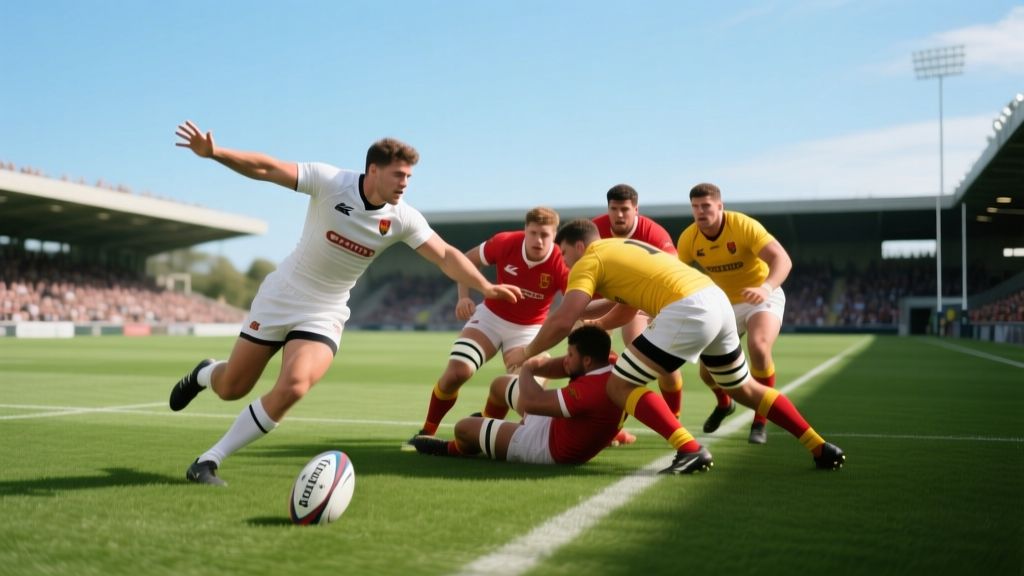
How Long Do Rugby Games Last? Full Breakdown by Format
Rugby games typically last 80 minutes for professional matches, divided into two 40-minute halves with a 10- to 15-minute halftime break. However, total event duration including stoppages, injuries, and extra time can extend the game to around 100–120 minutes.
Understanding Rugby Game Duration
Rugby is a dynamic sport with strict time regulations, but actual match length varies based on level of play, format, and competition rules. At the elite level, such as international Test matches or club competitions like the Six Nations or Super Rugby, games are scheduled for 80 minutes of playing time. This is split into two halves of 40 minutes each. The clock stops only for serious injuries or major disruptions, meaning effective game time often exceeds scheduled minutes due to stoppage time added by the referee.
Standard Match Structure
- Two halves: Each lasting 40 minutes in professional rugby union.
- Halftime break: Typically 10–15 minutes long.
- Stoppage time: Added at the referee’s discretion for injuries, substitutions, or delays.
- Extra time: Applied in knockout stages if scores are tied after regulation.
Rugby Formats and Their Durations
Different formats of rugby have distinct time structures. The two main variants—Rugby Union and Rugby Sevens—differ significantly in match length and pace.
Rugby Union vs. Rugby Sevens
Rugby Union, the traditional form, features 15 players per side and an 80-minute game. In contrast, Rugby Sevens, popularized by the World Rugby Sevens Series and Olympic Games, uses seven players and shorter halves to accommodate fast-paced tournaments.
| Rugby Format | Players per Team | Half Duration | Total Playing Time | Halftime Length |
|---|---|---|---|---|
| Rugby Union (Men) | 15 | 40 min | 80 min | 10–15 min |
| Rugby Union (Women) | 15 | 40 min | 80 min | 10–15 min |
| Rugby Sevens (Men) | 7 | 7 min | 14 min | 2 min |
| Rugby Sevens (Women) | 7 | 7 min | 14 min | 2 min |
| U18 School Rugby | 15 | 35 min | 70 min | 10 min |
| Varsity/College Level | 15 | 40 min | 80 min | 10–15 min |
The table highlights key differences in game duration across formats and age groups. Professional 15-a-side matches maintain consistent 80-minute durations, while Rugby Sevens drastically reduces playing time to 14 minutes per game to allow multiple matches in a single day. Youth and school-level games often shorten halves to suit player development and safety.
Factors That Extend Game Time
Although regulated playing time is fixed, several factors contribute to longer real-world match durations:
- Injury stoppages: Referees may pause the clock for medical attention.
- Video Assistant Referee (VAR) reviews: Common in professional leagues, adding delays.
- Substitutions: Tactical or injury-related changes consume time.
- TMO checks: Television Match Official reviews for tries or foul play.
- Crowd incidents or weather delays: Rare but possible causes of extended breaks.
As a result, spectators should expect a full rugby union match to take approximately 1 hour and 45 minutes from kickoff to final whistle, including halftime and stoppages.
Extra Time and Tiebreaker Rules
In knockout competitions like the Rugby World Cup or domestic playoffs, tied scores after 80 minutes lead to extra time. The structure includes:
- Two 10-minute halves: Sudden death may apply depending on tournament rules.
- Golden point: First team to score during extra time wins (used in some leagues).
- Penalty shootout: Rarely used; more common in youth or exhibition matches.
For example, during the 2023 Rugby World Cup, knockout stage matches could extend up to 100 minutes of playing time before reaching a decisive outcome.
Frequently Asked Questions About Rugby Game Length
How long is a professional rugby match?
A professional rugby match lasts 80 minutes, played in two 40-minute halves, with a 10- to 15-minute halftime break. Including stoppages and referee decisions, the total event usually takes about 1 hour and 45 minutes.
Do women's rugby matches have the same duration as men's?
Yes, women's rugby union matches also consist of two 40-minute halves, totaling 80 minutes of play. Women's Rugby Sevens follows the same 7-minute half format as the men’s game.
How long does a Rugby Sevens game last?
A Rugby Sevens match lasts 14 minutes total—two halves of 7 minutes each—with a 2-minute halftime. Finals may extend to 10-minute halves. Due to quick turnaround, tournaments can host multiple games per day.
Is there stoppage time in rugby?
Yes, referees add stoppage time at the end of each half for injuries, substitutions, and video reviews. Unlike soccer, the clock runs continuously during active play, but the referee controls when to resume after interruptions.
What happens if a rugby match ends in a draw?
In league play, draws are allowed. In knockout stages, tied matches go into extra time (two 10-minute halves). If still tied, sudden death or a kicking competition may decide the winner, depending on the competition rules.
More Articles
 What Month Is the Super Bowl? Answer & Key Dates
 Who Won Super Bowl 1996? Cowboys Beat Steelers 27-17
 How Big Are Tennis Balls? Official Size & Weight Explained
 Where Was Tennis Founded? The True Origin Explained
 Super Bowl 2024 Viewership: How Many Watched?
 How Are Pro Bowl Players Selected? Full Breakdown
 NFL Teams That Have Never Been to the Super Bowl
 Who Won the 1989 Super Bowl? 49ers Victory Details
 Coach with Most Super Bowl Wins: Bill Belichick's Legacy
 How Much Is a Mickey Mantle Baseball Card Worth?