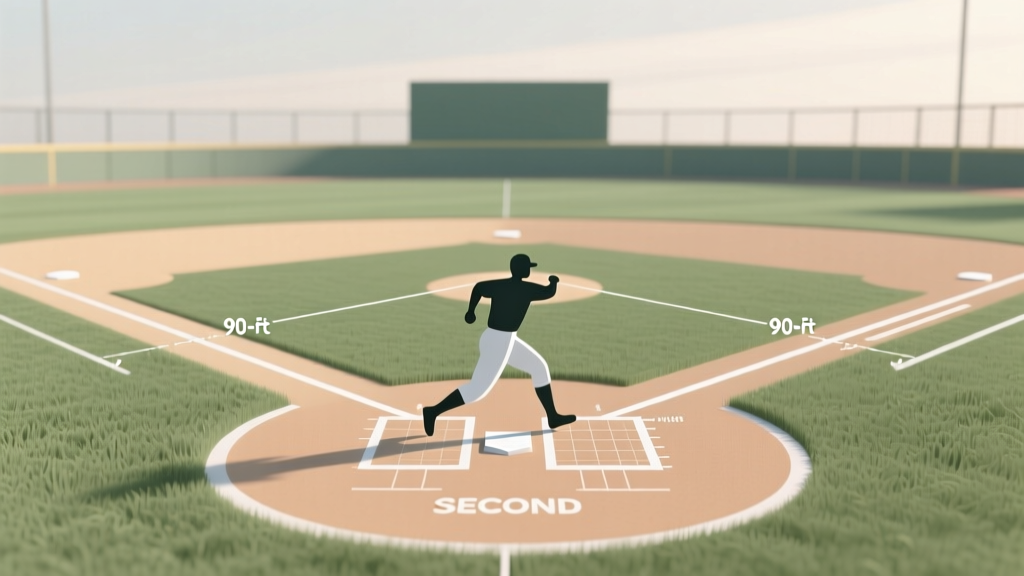
How Far Are Bases in Baseball? 90 Feet Explained
In professional and standard regulation baseball, the distance between bases is exactly 90 feet (27.43 meters). This measurement applies to all base paths — from home plate to first base, first to second, second to third, and third back to home — forming a perfect diamond shape. This 90-foot spacing has been a consistent rule in Major League Baseball (MLB), NCAA, and high school baseball (NFHS) for decades, ensuring uniformity in gameplay, defensive strategy, and player performance across these levels.
Understanding Base Distances in Baseball
The 90-foot baseline is a foundational element of baseball's field dimensions. It directly impacts game dynamics including base running speed, infield defensive range, throwing accuracy, and overall strategy. The consistent spacing allows players to train with predictable mechanics and enables fair comparisons of performance across games and leagues.
Why Is the Distance Between Bases 90 Feet?
The 90-foot base path was officially standardized in 1857 by the National Association of Base Ball Players and later adopted by professional leagues. This distance was chosen as a balance between offensive action and defensive capability:
- A shorter distance would favor base stealing and infield hits too heavily.
- A longer distance would slow down the game and reduce close plays.
- Ninety feet creates optimal tension between runners and defenders, especially on ground balls and steal attempts.
Differences Across Age Groups and Leagues
While 90 feet is standard at the highest levels, youth and amateur leagues modify base distances to suit player development and field size limitations.
| League / Age Group | Base Distance (feet) | Base Distance (meters) | Pitching Distance (feet) |
|---|---|---|---|
| MLB, NCAA, NFHS (High School) | 90 | 27.43 | 60.5 |
| 13-14 Year Olds (Intermediate) | 75 | 22.86 | 54 |
| 12U Little League | 60 | 18.29 | 46 |
| 9-10 Year Olds (Minor League) | 60 | 18.29 | 46 |
| Under 8 (T-Ball) | 50 | 15.24 | 38-42 |
The data shows a clear progression in base distances as players age and develop physically. Smaller fields for younger players accommodate shorter attention spans, developing coordination, and safety considerations. The jump from 60 feet in Little League to 90 feet in high school represents a significant physical challenge that requires improved speed, throwing strength, and field awareness.
How Base Distance Affects Gameplay
The 90-foot base path influences multiple aspects of baseball strategy and athlete performance:
- Base Running: Elite runners can round the bases in under 14 seconds. The distance determines how quickly a runner can advance and whether they can beat throws.
- Infield Defense: Shortstops and second basemen must cover more ground at 90 feet, requiring greater range and arm strength.
- Stolen Base Success Rate: In MLB, a success rate above 75% is generally required to make stealing worthwhile due to the risk-reward balance shaped by base distance.
- Double Play Execution: Turn times are critical; a fraction of a second difference in transfer and throw is magnified over 90 feet.
Measuring the Base Path Correctly
The 90-foot measurement is not from the back tip of home plate to the back corner of first base. Instead, it is measured from the back edge of home plate to the farthest corner of first base (the one touching the foul line), following the inside corner of the base. Each base is positioned so that the corner facing the previous base touches the end of the measured line.
- Home to first: 90 feet from rear point of home plate to outside corner of first base.
- First to second: 90 feet from outer corner of first to outer corner of second.
- The same rule applies around the diamond.
This ensures that when a runner touches the base within the baseline, they are on the correct path without cutting corners.
Frequently Asked Questions About Base Distances in Baseball
How far is it from home plate to first base in MLB?
The distance from the back edge of home plate to first base in Major League Baseball is exactly 90 feet (27.43 meters).
Are all bases the same distance apart in professional baseball?
Yes, in professional baseball, the distance between each base — home to first, first to second, second to third, and third to home — is uniformly 90 feet.
How far is it from the pitcher’s mound to home plate?
In MLB, the distance from the front of the pitcher’s rubber to the rear point of home plate is 60 feet 6 inches (18.44 meters).
Why do youth leagues use shorter base paths?
Youth leagues use shorter base paths (e.g., 60 feet in Little League) to match the physical development of younger players, improve safety, and maintain competitive balance during skill acquisition.
Does the base distance affect stolen base strategies?
Yes, the 90-foot distance makes stolen base attempts a high-risk, high-reward play. Runners must time the pitcher’s move precisely, as even a 0.2-second delay can result in being thrown out by a well-armed catcher.
More Articles
 Where Does Judo Come From? Origin and History Explained
 What Year Was the First Super Bowl? (1967)
 A Rus Tennis: Top Players & 2025 Insights
 How Old Is John McEnroe? Age & Career Facts (2025)
 What to Wear at the Masters Golf Tournament
 What Does VIP Do in Volleyball Legends?
 When Did the Eagles Win Their First Super Bowl?
 Who Invented Table Tennis? Origins & Key Inventors
 Best Pitcher in MLB 2025: Who Leads the League?
 Why Is Baseball Popular in Japan? Key Reasons Explained