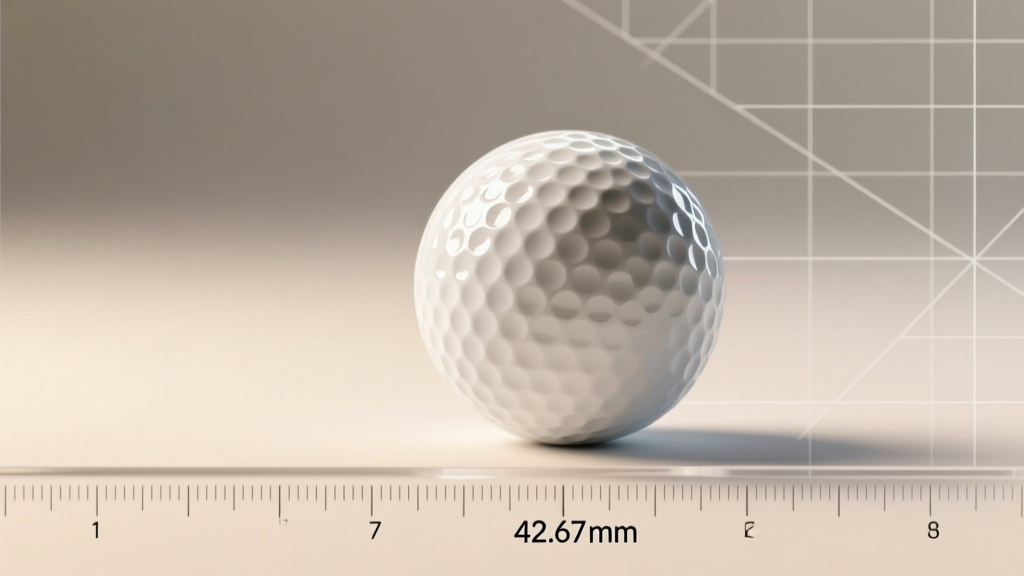
How Big Are Golf Balls? Official Size Explained
Golf balls must have a minimum diameter of 1.68 inches (42.67 mm) according to the official rules set by the R&A and USGA, ensuring consistency in professional and amateur play worldwide.
Standard Golf Ball Size Regulations
The size of a golf ball is strictly regulated to maintain fairness and uniformity across all levels of the game. The current standard is established by two governing bodies: the United States Golf Association (USGA) and The R&A (The Royal and Ancient Golf Club of St Andrews).
Key Regulatory Requirements
- The minimum diameter of a golf ball is 1.68 inches (42.67 mm).
- Balls smaller than this are not permitted in sanctioned play.
- There is no maximum diameter under R&A rules, but the USGA caps it at 1.68 inches.
- Any ball conforming to these standards is eligible for tournament use.
This regulation has been in place since 1990 when the USGA adopted the British standard, unifying global specifications. Prior to that, American-made balls were slightly smaller (1.62 inches), giving them a marginal aerodynamic advantage.
Golf Ball Dimensions Across Major Brands
While regulations define the minimum size, most manufacturers produce balls very close to or exactly at the 1.68-inch threshold. Below is a comparison of popular golf ball models and their actual dimensions.
| Brand & Model | Diameter (inches) | Diameter (mm) | Weight (g) | Compression |
|---|---|---|---|---|
| Titleist Pro V1 | 1.680 | 42.67 | 45.93 | 100 |
| Callaway Chrome Soft | 1.680 | 42.67 | 45.87 | 90 |
| Srixon Z-Star | 1.680 | 42.67 | 45.90 | 102 |
| Mizuno RB566 | 1.680 | 42.67 | 45.85 | 105 |
| Vice Pro Plus | 1.680 | 42.67 | 45.91 | 98 |
All major golf ball brands adhere closely to the 1.68-inch diameter standard, with negligible variation between models. This uniformity ensures predictable flight characteristics and fair competition. Minor differences in weight and compression affect performance more than size.
Why Golf Ball Size Matters
The standardized size of golf balls impacts several aspects of the game:
Aerodynamics and Flight Performance
- Larger balls experience more air resistance, affecting carry distance.
- Uniform size allows consistent dimple design, influencing lift and drag.
- Regulated dimensions ensure predictable spin rates and trajectory control.
Equipment Compatibility
- Golf club grooves are designed to interact optimally with standard-sized balls.
- Putting surfaces and hole liners assume standard ball dimensions.
- Automated ball dispensers and driving range equipment rely on consistent sizing.
Historical Evolution of Golf Ball Size
In the early 20th century, American golf balls were typically 1.62 inches in diameter, while British balls were 1.68 inches. This discrepancy created inconsistencies in international play. In 1990, the USGA aligned with the R&A’s standard, mandating a 1.68-inch minimum, thus harmonizing global regulations.
Common Questions About Golf Ball Size
Are all golf balls the same size?
Yes, all regulation golf balls used in official play are required to have a minimum diameter of 1.68 inches (42.67 mm). While minor manufacturing variances exist, they are negligible, and all major brands produce balls within this standard.
Can I use a smaller golf ball in tournaments?
No, golf balls smaller than 1.68 inches are not permitted in USGA or R&A-sanctioned events. Using a non-conforming ball results in disqualification under Rule 4.1b(2) of the Rules of Golf.
Does golf ball size affect driving distance?
Yes, ball size influences aerodynamics. A larger ball creates more drag, potentially reducing distance. However, since all legal balls meet the same size standard, differences in distance are primarily due to construction, materials, and dimple patterns rather than diameter.
What happens if a golf ball is too small?
If a golf ball is below the 1.68-inch minimum, it is deemed non-conforming. Players using such balls in competition risk disqualification. Manufacturers rigorously test balls to ensure compliance before market release.
How do you measure a golf ball's diameter accurately?
A golf ball’s diameter can be measured using digital calipers for precision. Measurements should be taken at multiple points around the ball to account for dimple variations. Conforming balls will consistently read at or above 1.68 inches (42.67 mm).
More Articles
 How Much Does a Rugby Union Player Earn? (2025 Data)
 Where Are PING Golf Clubs Manufactured? | Made in USA
 LSU Baseball Score Today: Final Result & Game Recap
 Who Played in Super Bowl 2022? Teams, Score & Highlights
 Where to Play Table Tennis: Best Locations & Tips
 Super Bowl 2025 Halftime Viewership: How Many Watched?
 Who Has Been to the Most Super Bowls? Tom Brady's Record
 When Was Super Bowl I Played? Key Facts & History
 How Many Innings Was the Longest Baseball Game?
 How Much Is a Babe Ruth Signed Baseball Worth?