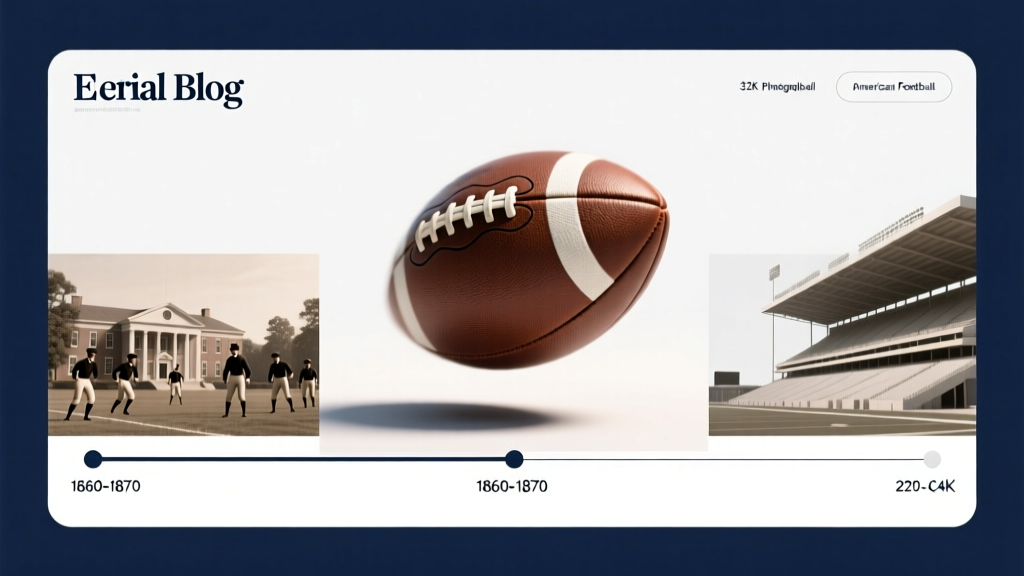
When Was American Football Founded? Key Origins Explained
American football was officially founded in 1869 when the first intercollegiate game was played between Rutgers and Princeton, marking the sport's origin as a distinct form of football in the United States.
The Birth of American Football
The foundation of American football traces back to a pivotal moment in sports history: the first intercollegiate football game. This match took place on November 6, 1869, between Rutgers College and Princeton University (then known as the College of New Jersey). The game, played with a round ball and rules resembling soccer, laid the groundwork for what would evolve into modern American football.
Key Factors Leading to the Sport's Creation
- Rising popularity of rugby and soccer among Ivy League schools
- Lack of standardized rules across institutions
- Influence of British football games adapted to American college culture
- Demand for a uniquely American team sport
Evolution of Rules and Structure
While the 1869 game resembled soccer, significant rule changes over the following decades transformed the game into a distinct sport. Walter Camp, often called the "Father of American Football," introduced critical innovations such as the line of scrimmage, the snap from center, and the system of downs.
Milestones in Rule Development
- 1873: Representatives from Yale, Columbia, Princeton, and Rutgers formed the Intercollegiate Football Association and adopted standardized rules based on rugby.
- 1880: Walter Camp proposed the down-and-distance system, shifting the game away from rugby-style continuous play.
- 1906: The forward pass was legalized to reduce injuries and open up gameplay.
- 1920: The American Professional Football Association (later renamed NFL) was founded, formalizing professional competition.
| Year | Event | Significance |
|---|---|---|
| 1869 | Rutgers vs. Princeton Game | First intercollegiate football game in U.S., considered the birth of American football |
| 1873 | Formation of Intercollegiate Football Association | Standardized early rules based on rugby union |
| 1880 | Walter Camp introduces downs system | Critical divergence from rugby, established strategic structure |
| 1906 | Legalization of forward pass | Reduced reliance on brute force, increased offensive complexity |
| 1920 | Founding of APFA (NFL) | Establishment of professional league that shaped modern football |
The data highlights key turning points in the sport’s development, showing how rule changes and organizational milestones directly influenced its evolution. The transition from a soccer-like game in 1869 to a structured, professional sport by 1920 illustrates rapid innovation driven by safety concerns and competitive strategy.
Collegiate Influence and National Expansion
College football served as the incubator for American football. Schools like Harvard, Yale, and Princeton experimented with rules and gameplay, leading to regional variations. The spread of the sport across universities helped solidify its cultural significance and paved the way for professional leagues.
Major Contributions by Universities
- Harvard introduced rugby-style tackling and carrying the ball, influencing physical play
- Yale and Princeton developed early coaching systems and training regimens
- Midwestern schools expanded the game beyond the East Coast, increasing national appeal
Professionalization and the NFL Era
The formation of the American Professional Football Association (APFA) in 1920 marked the official beginning of professional American football. Renamed the National Football League (NFL) in 1922, the league gradually gained prominence through television broadcasts, star players, and strategic marketing.
Key Developments in Professional Football
- 1958 NFL Championship Game dubbed "The Greatest Game Ever Played," boosting national interest
- 1960 AFL formation introduced competition and eventually led to the Super Bowl era
- Merging of NFL and AFL in 1970 created a unified major league
- Television contracts in the 1960s–1980s transformed football into America's most-watched sport
Frequently Asked Questions About When American Football Was Founded
When was the first American football game played?
The first intercollegiate American football game was played on November 6, 1869, between Rutgers and Princeton. Although the rules differed significantly from today’s game, this event is widely recognized as the sport’s origin.
Who invented American football?
No single person invented American football, but Walter Camp is considered the "Father of American Football" for his role in developing key rules like the line of scrimmage, the snap, and the down system during the 1880s.
How is American football different from rugby?
American football differs from rugby in several ways: it allows forward passes, uses protective gear, has a stop-start format with downs, and emphasizes set plays. Rugby features continuous play, no blocking, and minimal padding.
When did the NFL start?
The NFL was founded in 1920 as the American Professional Football Association (APFA) and was renamed the National Football League in 1922. It has since become the premier professional football league in the world.
Was American football always called football?
Yes, despite using hands more than feet, the term "football" was inherited from earlier forms of the game rooted in English public school football games. The name stuck even as the sport evolved into a predominantly hand-based game.
More Articles
 What Does Secondary Mean in Football? Explained
 What Does a Defensive Back Do in Football?
 How Many Football Championships Does Notre Dame Have?
 What Channel Is NFL Football on DIRECTV Today?
 When Was the Last NCAA Football Video Game Released?
 Who Owns Liverpool Football Club? FSG Ownership Explained
 Loudest College Football Stadium: Record Holder Revealed
 How Many Football Teams Are in New York? (2025)
 How Many College Football Conferences Are There in 2025?
 Football Field Size in Feet: Dimensions Explained