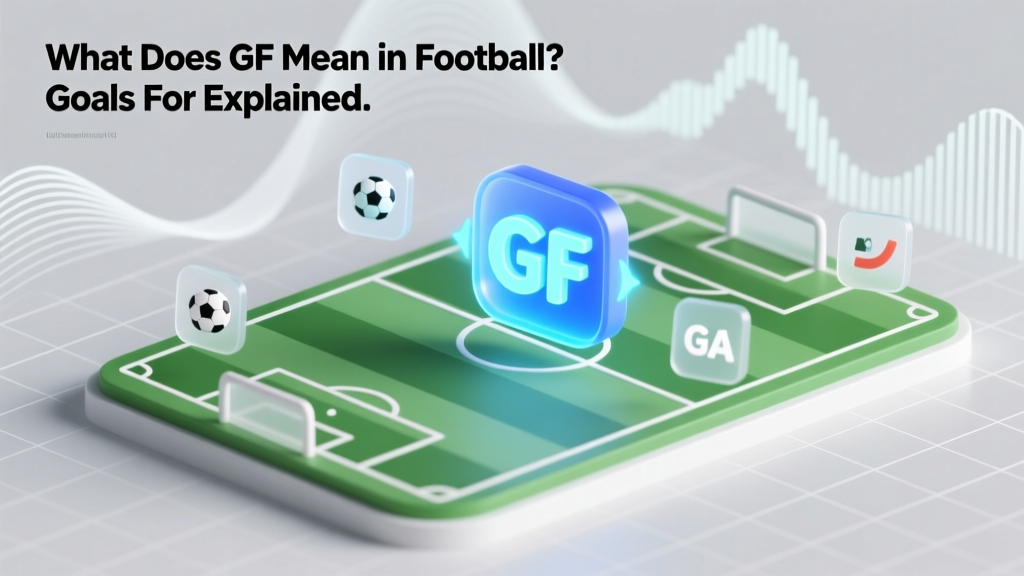
What Does GF Mean in Football? Goals For Explained
In football, GF stands for Goals For, representing the total number of goals a team has scored in a given period, such as a season or tournament. It is a key metric used to evaluate offensive performance and is often paired with GA (Goals Against) to calculate goal difference (GD).
What Does GF Mean in Football?
GF, or Goals For, is a fundamental statistic in football that indicates how many goals a team has scored across matches. Whether in league standings, tournament tables, or player evaluations, GF helps assess a team’s attacking strength and overall competitiveness.
Why Is GF Important in Football?
- Measures offensive efficiency: A high GF suggests a potent attack.
- Used in tiebreakers: In leagues with tied points, GF can determine rankings.
- Calculates goal difference: GD = GF - GA, which often influences final standings.
- Team strategy analysis: Coaches use GF trends to refine tactics and formations.
- Player contribution tracking: Helps link individual performances (e.g., strikers, playmakers) to team output.
How GF Is Used in League Standings
In most football leagues, including the English Premier League, La Liga, and Bundesliga, GF appears in the league table alongside other stats like wins, draws, losses, and goal difference. When teams are level on points, tiebreaker rules often prioritize goal difference, followed by GF if needed.
Example Tiebreaker Hierarchy (Standard Format):
- Points earned
- Goal Difference (GD)
- Goals For (GF)
- Head-to-head record
- Fair play points or drawing of lots
GF vs. GA vs. GD: Understanding the Differences
While GF measures goals scored, it's essential to distinguish it from related metrics:
- GA (Goals Against): Total goals conceded by a team.
- GD (Goal Difference): The net balance of goals, calculated as GF minus GA.
A team with a high GF but also a high GA may have an inconsistent defense, whereas a strong GD usually reflects balanced performance.
| Team | Season | GF | GA | GD | Final League Position |
|---|---|---|---|---|---|
| Manchester City | 2017-18 | 106 | 27 | +79 | 1st |
| Liverpool | 2019-20 | 85 | 33 | +52 | 1st |
| Bayern Munich | 2022-23 | 87 | 38 | +49 | 1st |
| Inter Milan | 2023-24 | 74 | 29 | +45 | 1st |
| PSG | 2022-23 | 90 | 37 | +53 | 1st |
The data shows that top-performing teams consistently achieve high GF values. Manchester City’s 106 goals in 2017-18 remains a Premier League record, underscoring their offensive dominance. High GF, when paired with low GA, leads to superior GD and increases title-winning chances.
Common Misconceptions About GF
Some fans mistakenly believe GF alone determines success. However, while crucial, GF must be analyzed alongside GA and match context. For example, a team might score many goals but still lose games due to poor defense. Additionally, GF does not account for shot quality, xG (expected goals), or match pressure situations.
Frequently Asked Questions About GF in Football
What does GF mean in football standings?
GF stands for Goals For and represents the total number of goals a team has scored in the competition. It is displayed in league tables and used to assess offensive performance.
Is a high GF always a sign of a good team?
Not necessarily. While a high GF indicates strong attacking play, it doesn’t reflect defensive stability. A team with high GF but even higher GA may struggle to win titles without balanced performance.
How is GF different from expected goals (xG)?
GF is the actual number of goals scored, while xG (expected goals) is a statistical model estimating how many goals a team should have scored based on shot quality, position, and difficulty.
Can GF be used to evaluate individual players?
Indirectly, yes. Strikers and attacking midfielders contribute directly to GF. Player stats like goals scored and assists are components of a team’s overall GF tally.
Do cup competitions track GF the same way as leagues?
Yes, GF is recorded in cup tournaments too. However, unlike leagues, knockout stages rely more on aggregate scores and away goals (in some formats), making GF less influential than match outcomes.
More Articles
 Why Is Soccer Called Football? Origins Explained
 Who Is the Highest Goal Scorer in Football History?
 Swim Gear Cleaning: Protocol for Swimmers
 Wisconsin Badgers Play Today at 3:30 PM CT
 Did Matthew McConaughey Play Football? The Truth Revealed
 Lionel Messi: Career Stats, Awards & Legacy
 What Position Did Deion Sanders Play in Football?
 When Did England Win the Football World Cup?
 Where to Watch Football Live: Top Streaming Services 2025
 What Does a Wide Receiver Do in Football?