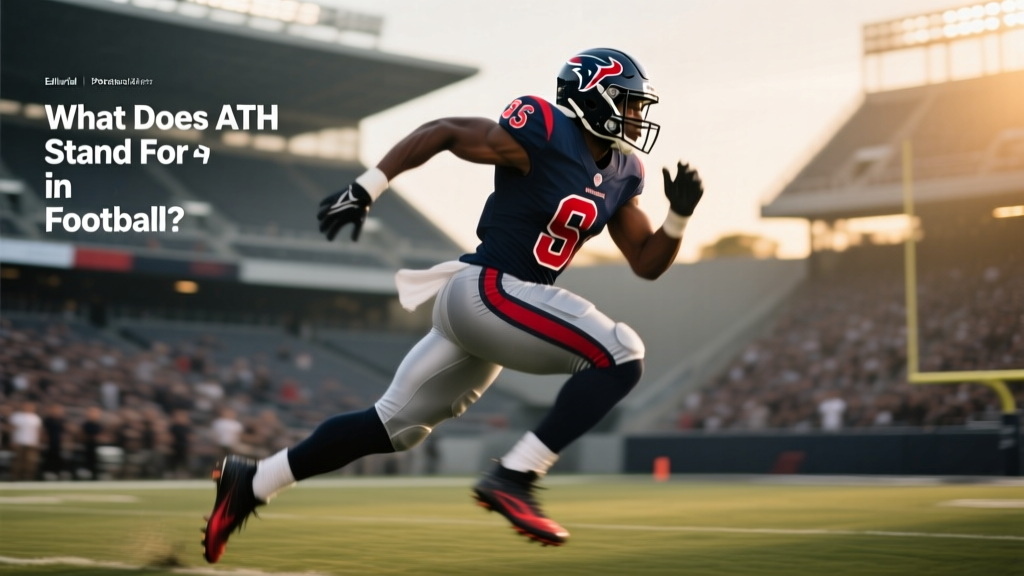
What Does ATH Stand For in Football?
ATH in football stands for athleticism, a term used to describe a player's overall physical abilities such as speed, strength, agility, endurance, and coordination. While not an official stat or acronym in league records, "ath" is often shorthand in scouting reports, fantasy football analysis, and sports commentary to highlight a player’s raw physical talent and movement skills on the field.
Understanding ATH in Football Context
In American football, the abbreviation ATH most commonly stands for Athlete. This positional designation is used by coaches, scouts, and analysts to classify players who possess versatile skill sets across multiple positions, typically due to exceptional athleticism.
What Does ATH Mean on Rosters and Recruiting Boards?
When you see "ATH" listed as a position in college recruiting profiles (e.g., ESPN, 247Sports) or NFL draft evaluations, it indicates that the player hasn't been locked into a specific role like quarterback (QB), linebacker (LB), or wide receiver (WR). Instead, their value lies in adaptability and physical potential.
- Versatility: ATH players can often play safety, wideout, slot corner, or even wildcat QB.
- Recruiting Flexibility: Coaches use ATH to sign athletes they plan to develop based on team needs.
- Scouting Emphasis: Scouts focus on measurable traits (40-time, vertical jump, etc.) over defined skill sets.
How ATH Differs From Other Positional Labels
Unlike traditional abbreviations such as DE (Defensive End) or CB (Cornerback), ATH doesn't denote a fixed role. It reflects uncertainty about where the athlete will best contribute.
Common Positional Abbreviations in Football
| Abbreviation | Position | Typical Role |
|---|---|---|
| QB | Quarterback | Offensive leader, passer |
| RB | Running Back | Ball carrier, rusher |
| WR | Wide Receiver | Route runner, pass catcher |
| TE | Tight End | Hybrid blocker/receiver |
| ATH | Athlete | Multi-position prospect |
| S | Safety | Defensive backfield coverage |
The table highlights how ATH stands out as a non-specific label focused on potential rather than duty. While other positions have clear responsibilities, ATH signals developmental opportunity.
Notable ATH Players in Modern Football
Some of the most dynamic performers in recent years began as ATH prospects before being molded into stars at defined roles.
- Trevon Moehrig – Listed as ATH in high school (247Sports), later became a starting safety at TCU and drafted by Las Vegas Raiders.
- Devin Duvernay – Reclassified from ATH to WR at Texas, now plays for Baltimore Ravens with special teams excellence.
- Kadarius Toney – Originally labeled ATH, transitioned to WR at Florida and known for versatility in Kansas City Chiefs' offense.
Why Teams Value ATH Designations
Coaching staffs prize ATH-labeled recruits because they offer strategic flexibility. In modern spread offenses and complex defensive schemes, having players who can shift roles provides tactical advantages.
ATH vs. Other Hybrid Roles
While similar to designations like "Joker" or "H-back", ATH is broader and less formation-specific. Here's how it compares:
- ATH: General athletic profile; undefined position.
- Utility Player: Actively used in multiple roles during games (e.g., Tyreek Hill pre-draft).
- Situational Flex: Rotates between positions based on down & distance.
The key distinction is that ATH usually applies pre-development, while utility roles emerge post-skill refinement.
Frequently Asked Questions About ATH in Football
What does ATH mean on ESPN football profiles?
On ESPN and major recruiting platforms, ATH stands for "Athlete", indicating a high-potential player whose final position hasn't been determined. It’s commonly used for five-star recruits with elite measurables but undeveloped technical skills.
Is ATH a real position in the NFL?
No, ATH is not an official NFL position. Players labeled ATH in college are eventually assigned specific roles (WR, S, CB, etc.). However, some retain hybrid duties—like Deebo Samuel, dubbed a "wide back"—reflecting their original ATH-like versatility.
Can an ATH become a quarterback?
Yes. Many dual-threat QBs were labeled ATH coming out of high school due to superior running ability. Lamar Jackson was initially considered an ATH before committing to QB at Louisville, where his athleticism shined in a designed rushing system.
Do fantasy football leagues recognize ATH?
No major fantasy platform uses ATH as a scoring position. Players must be rostered under standard roles (QB, RB, WR, TE). However, in custom or dynasty leagues, savvy managers target former ATH recruits anticipating breakout roles.
Why do recruiters use ATH instead of assigning a position?
Recruiters use ATH to preserve options. If a player excels in track, basketball, and football, labeling them solely as WR or DB might misrepresent their potential. ATH keeps the door open for development based on team need, physical maturation, and coaching strategy.
More Articles
 Don Bosco Football NJ: Program Overview & Stats
 What Position Is DB in Football? Explained
 How Big Is a Football Goal? Official Size & Dimensions
 Saturday Night Football: Teams & Schedule (2026)
 When Did Football Become a Sport? Key Dates Explained
 How Much Do Arena Football Players Make in 2025?
 Football Matchday: Rules and Checklist
 What Does Secondary Mean in Football? Explained
 Where Do the Panthers Play Football? Home Stadium Info
 How Many Weeks in NFL Football? Full Season Breakdown