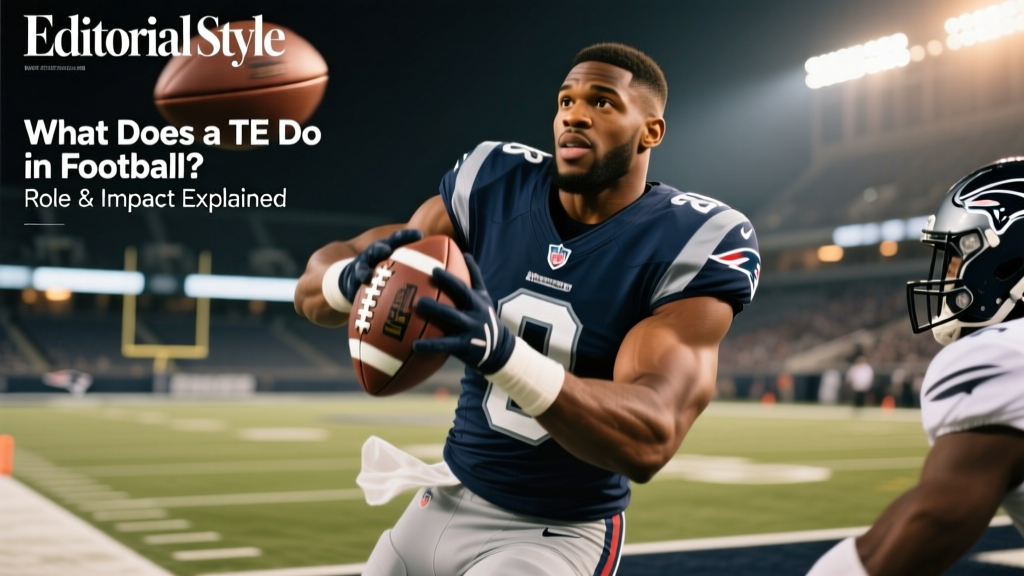
What Does a TE Do in Football? Role & Impact Explained
In football, a TE (tight end) is a hybrid position that combines the blocking skills of an offensive lineman with the receiving abilities of a wide receiver. The tight end lines up next to the offensive tackle and is responsible for both run blocking and running pass routes, making them a versatile weapon in modern offenses.
What Is a Tight End in Football?
The tight end (TE) is a key player on the offensive side of the football. Positioned on the line of scrimmage, typically aligned next to the offensive tackle, the TE serves a dual role: contributing as both a blocker and a pass catcher. This hybrid nature makes the tight end one of the most strategically valuable positions in today’s NFL and college football.
Core Responsibilities of a Tight End
- Run Blocking: TEs help create running lanes by sealing the edge against defensive ends and linebackers.
- Pass Protection: They assist offensive linemen in protecting the quarterback from blitzes.
- Route Running: TEs run precise patterns to get open for passes, often targeting the middle of the field.
- Red Zone Threat: Due to their size and hands, tight ends are frequently targeted near the goal line.
- Flexibility in Formation: Can line up in-line, split out wide, or even in the backfield depending on scheme.
Evolution of the Tight End Position
Historically, tight ends were primarily blockers, used to strengthen the offensive line. However, over the past three decades, the role has evolved significantly. Modern offenses, especially those using spread and multiple-receiver sets, have turned the TE into a primary receiving option.
Notable Changes in TE Usage
- 1980s–1990s: Emphasis on blocking; few TEs recorded over 500 receiving yards annually.
- 2000s: Emergence of athletic TEs like Tony Gonzalez and Shannon Sharpe who redefined the position.
- 2010s–Present: TEs like Travis Kelce and George Kittle are central to passing attacks, often ranking among top receivers league-wide.
| Player | Team (2024) | Receptions (2023) | Receiving Yards (2023) | Touchdowns (2023) | Pro Bowls |
|---|---|---|---|---|---|
| Travis Kelce | Kansas City Chiefs | 110 | 1,338 | 12 | 10 |
| George Kittle | San Francisco 49ers | 78 | 1,081 | 6 | 6 |
| Mark Andrews | Baltimore Ravens | 64 | 764 | 4 | 3 |
| T.J. Hockenson | Minnesota Vikings | 61 | 579 | 3 | 1 |
| Dallas Goedert | Philadelphia Eagles | 42 | 502 | 3 | 2 |
The data shows that elite tight ends like Travis Kelce are producing at levels comparable to top wide receivers. Kelce’s 1,338 yards and 12 touchdowns in 2023 highlight how dominant a modern TE can be in a pass-heavy offense. The gap between traditional WR production and top-tier TEs continues to shrink, reinforcing the strategic importance of the position.
Types of Tight Ends
Coaches and analysts often categorize tight ends based on their skill set and role within the offense.
Blocking Tight End
Focused on run support and pass protection. These players are typically larger, stronger, and less involved in the passing game. Examples include Jared Cook (earlier career) and Nick Vannett.
Receiving Tight End
Athletic players with excellent hands and route-running ability. They line up in various spots and are frequently targeted. Travis Kelce and Darren Waller are prime examples.
Move Tight End
Often lighter and faster, these TEs are used in motion or flexed out to create mismatches against linebackers. They may even line up as slot receivers. Kyle Pitts exemplifies this prototype.
Why Are Tight Ends So Important Today?
The modern NFL emphasizes spacing, tempo, and exploiting mismatches. The tight end is uniquely positioned to thrive in this environment.
- Mismatch Creation: A fast, agile TE can outrun linebackers and outmuscle safeties.
- Third-Down Weapon: TEs are reliable targets on intermediate routes like slants, seams, and curls.
- Chemistry with Quarterbacks: Many QBs trust TEs in critical situations due to their size and sure hands.
- Formation Flexibility: Teams use TEs to shift defensive alignments pre-snap, creating advantageous looks.
Common Questions About the Tight End Position
What does TE stand for in football?
TE stands for tight end, a position on the offensive team that combines blocking and receiving responsibilities.
Is a tight end considered a receiver or a lineman?
A tight end is officially part of the offensive line because they line up on the line of scrimmage, but they are eligible receivers and often function as hybrid players between linemen and wide receivers.
Who is the best tight end in the NFL right now?
As of 2025, Travis Kelce of the Kansas City Chiefs is widely regarded as the top tight end due to his consistent elite production, leadership, and postseason success.
Can a tight end throw the ball?
Yes, any player can throw the ball as long as the pass is behind the line of scrimmage and only one forward pass is thrown per play. While rare, some TEs have completed passes on trick plays.
How do you train to become a successful tight end?
Training involves building strength for blocking, improving route precision, enhancing hand-eye coordination, and developing stamina to handle both physical blocking and extensive route running during games.
More Articles
 Who Are the Thursday Night Football Announcers in 2025?
 Sunday Night Football 2026: Time & How to Watch
 Where to Watch NFL Football Today: Live Streams & TV Guide
 How Many Days Until College Football 2025?
 Football Games This Sunday: Oct 26, 2026 Schedule
 Who Owns the National Football League?
 Who Did Terry Crews Play Football For? NFL & College Teams
 College Football Game Length: Average Duration (2026)
 Has Oregon Won a Football National Championship?
 What Do Football Helmet Stickers Mean?