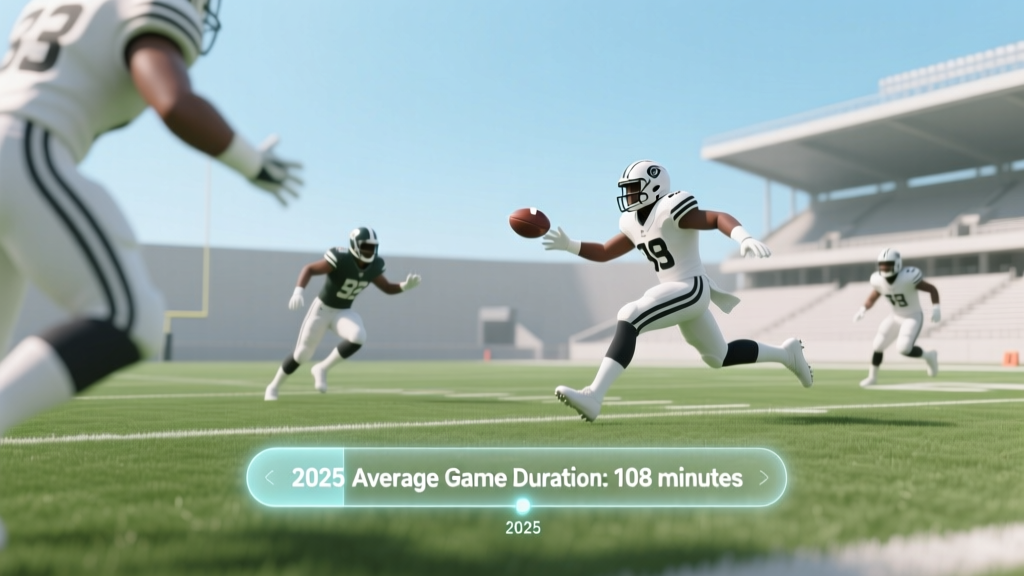
How Long Is an Average Football Game? (2025 Data)
An average football game, specifically referring to American football at the professional (NFL) level, lasts approximately 3 hours and 12 minutes in real time, despite consisting of only 60 minutes of scheduled play. This duration includes four 15-minute quarters, halftime, timeouts, stoppages for reviews, injuries, commercials, and breaks between plays.
Understanding the Duration of an Average Football Game
While the official playing time in an NFL game is 60 minutes—divided into four 15-minute quarters—the actual broadcast and stadium experience typically extend far beyond that. The average total runtime of an NFL game is around 3 hours and 12 minutes, according to recent data from Nielsen and NFL statistics. College football games run slightly longer, averaging about 3 hours and 24 minutes.
This extended duration results from multiple stoppages inherent in the sport's structure, including:
- Commercial breaks
- Quarter and halftime breaks
- Team timeouts
- Instant replay reviews
- Injury delays
- Play clock and snap count pauses
- Television timeouts
NFL vs. College vs. High School Game Lengths
Different levels of football follow similar rules but vary in timing, affecting overall game length. Below is a comparison of average durations across major levels of American football.
| League/Level | Regulation Playing Time | Average Real-Time Duration | Halftime Length | Timeouts per Team |
|---|---|---|---|---|
| NFL | 60 minutes (4 x 15-min quarters) | 3 hours 12 minutes | 12 minutes | 3 per half |
| NCAA (College) | 60 minutes (4 x 15-min quarters) | 3 hours 24 minutes | 20 minutes | 3 per game |
| High School | 48 minutes (4 x 12-min quarters) | 2 hours 15 minutes | 10–15 minutes | 3–5 per game (varies by state) |
| International (IFAF) | 60 minutes (4 x 15-min quarters) | ~3 hours | 15 minutes | 2 per half |
The data shows that while all levels share similar regulation times, college games are the longest due to longer halftimes and fewer restrictions on commercial and operational delays. NFL games are tightly managed but still exceed three hours due to extensive broadcasting requirements. High school games are significantly shorter, reflecting fewer media obligations and shorter quarters.
Why NFL Games Take Over 3 Hours
Although only 11 minutes of an NFL game involve actual action (per research by The Wall Street Journal), the remaining time consists of structured and unstructured breaks. Key contributors include:
- Television timeouts: Each quarter includes multiple ad breaks, especially after scores and during changeovers.
- Halftime: Lasts 12 minutes in the regular season and up to 30 minutes during the Super Bowl.
- Replay reviews: Coaches’ challenges and automatic reviews for scoring plays or end-zone actions add several minutes.
- Timeouts: Each team gets three per half, often used strategically at the end of halves.
- Player injuries: Mandatory evaluations pause the clock and delay play.
- End-of-game management: Clock-stopping strategies like spiking the ball or going out of bounds prolong close matches.
Overtime Rules and Their Impact on Game Length
Overtime can significantly extend a game’s duration. In the NFL regular season, overtime lasts up to 10 minutes (for preseason and regular season) or 15 minutes (postseason), with sudden death rules applying under certain conditions. College football uses a possession-based system, often lasting multiple possessions and adding 20–40 extra minutes.
Key differences:
- NFL regular-season OT: One 10-minute period; if tied, game ends in a draw (except playoffs).
- NFL postseason OT: 15-minute periods until a winner is decided.
- College OT: Teams get alternating possessions starting from the opponent’s 25-yard line; continues until one team leads at the end of a full round.
Games that go into overtime typically add 15 to 45 minutes to the total runtime, depending on the league and number of overtimes.
Efforts to Shorten Game Length
The NFL has explored various rule changes to reduce game duration and improve pacing. Recent initiatives include:
- Shortening the play clock from 40 to 25 seconds after certain stoppages.
- Limited commercial breaks during the final two minutes of each half.
- Reducing pregame ceremonies and halftime transitions.
- Encouraging faster substitutions and sideline management.
Despite these efforts, fan engagement and revenue from advertising make significant reductions unlikely in the near future.
Frequently Asked Questions About Football Game Length
How long is an average NFL game?
An average NFL game lasts about 3 hours and 12 minutes from kickoff to final whistle, including breaks, timeouts, and stoppages, even though the actual playing time totals only 60 minutes.
Why does a football game take so long if it's only 60 minutes long?
The 60 minutes of gameplay are stretched over a much longer period due to commercial breaks, halftime, timeouts, instant replay reviews, injuries, and the play clock. In reality, the ball is only in play for about 11 minutes per game.
How long is halftime in an NFL game?
Halftime in a regular-season NFL game is 12 minutes long. During the Super Bowl, halftime extends to approximately 30 minutes to accommodate the musical performance and production setup.
Do college football games last longer than NFL games?
Yes, on average, college football games last longer—about 3 hours and 24 minutes—due to longer halftimes (20 minutes), more frequent substitutions, and less strict control over broadcast timing compared to the NFL.
How long do high school football games last?
High school football games typically last around 2 hours and 15 minutes. They consist of four 12-minute quarters, shorter halftimes, and fewer commercial interruptions than professional or college games.
More Articles
 How Much Does an Arena Football Player Make?
 Who Won the College Football Championship 2025?
 How Was Football Made? Origins & Evolution
 What Does FNL Mean in Football? Explained
 How Many D3 Football Teams Are There? 2025 Update
 Football Game Times: NFL, Premier League & More (2026)
 Who Has the Hardest Schedule in College Football 2024?
 Who Has the Most Goals in Football? Messi Leads
 Football Field Dimensions: Size, Width & Length Explained
 When Will College Football 26 Be on Game Pass?