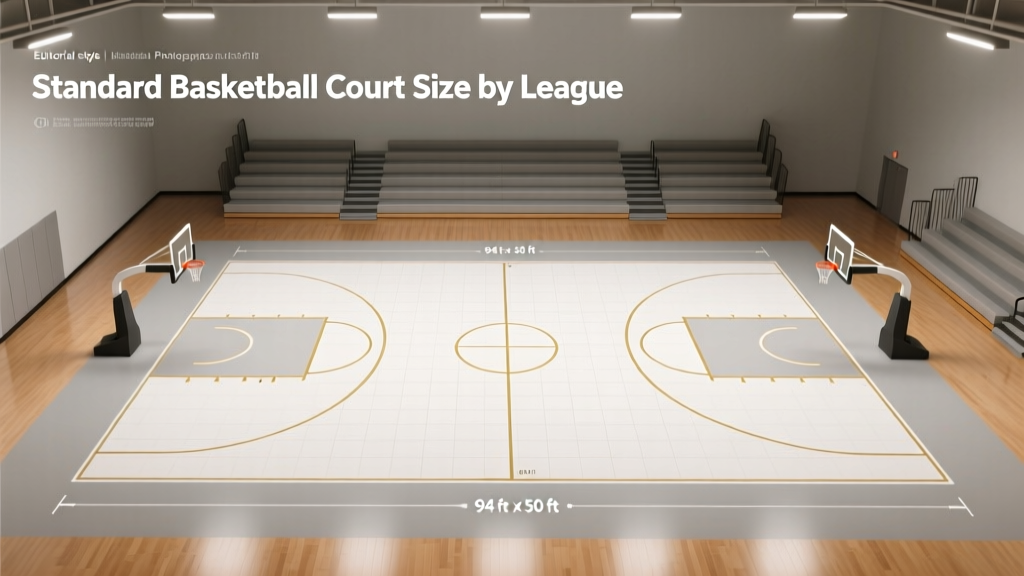
Standard Basketball Court Size by League
The standard size of a basketball court varies by league, but the most common dimensions are 94 feet by 50 feet (28.65 m by 15.24 m) for the NBA and FIBA courts measuring 28 meters by 15 meters (91.86 ft by 49.21 ft). These official sizes ensure consistency in gameplay across professional and international competitions.
Understanding Basketball Court Dimensions Across Leagues
Basketball court sizes differ based on the governing body and level of play. While all courts share the same fundamental layout—such as the key, three-point line, and center circle—the exact measurements can impact player movement, spacing, and strategy. Understanding these differences is essential for players, coaches, and facility planners.
Key Differences Between Major Basketball Organizations
- NBA courts are slightly longer and wider than FIBA standards.
- College (NCAA) courts follow NBA dimensions but may vary slightly in high school settings. \li>High school courts in the U.S. typically measure 84 feet by 50 feet.
- FIBA governs international competitions and uses metric-based court sizes.
Official Basketball Court Measurements by League
The following table details the standard dimensions of basketball courts used in major leagues and organizations worldwide. These measurements include overall court size, key areas, and three-point arc distances.
| League\/Organization | Length (ft) | Width (ft) | Length (m) | Width (m) | Three-Point Distance (ft) | Free Throw Line to Basket (ft) |
|---|---|---|---|---|---|---|
| NBA | 94 | 50 | 28.65 | 15.24 | 23.75 (varies by zone) | 15 |
| NCAA (Men) | 94 | 50 | 28.65 | 15.24 | 22.15 | 15 |
| NCAA (Women) | 94 | 50 | 28.65 | 15.24 | 20.75 | 15 |
| High School (NFHS) | 84 | 50 | 25.60 | 15.24 | 19.75 | 15 |
| FIBA | 91.86 | 49.21 | 28.00 | 15.00 | 22.15 | 15.09 |
The data shows that while NBA and NCAA courts are nearly identical in size, FIBA courts are slightly smaller in both length and width. The three-point line varies significantly, with the NBA using a longer distance in the corners compared to the top of the key. High school courts are notably shorter, which affects offensive spacing and transition speed.
Court Layout and Key Zones Explained
A basketball court is divided into several standardized zones that influence gameplay and officiating. Each area serves a specific purpose and must meet regulation size requirements.
Essential Court Markings and Their Functions
- Center Circle: Used for jump balls at the start of the game; typically 12 feet (3.66 m) in diameter.
- Free Throw Line: Located 15 feet from the backboard; marks where free throws are taken.
- The Key / Paint Area: Also known as the lane, it measures 16 feet wide in the NBA and 12 feet in FIBA.
- Three-Point Arc: Radius varies by league; shooters must have both feet behind this line to earn three points.
- Baseline and Sidelines: Define the boundaries of play; stepping on or over results in an out-of-bounds violation.
Variations in Professional and Amateur Courts
While professional leagues adhere strictly to standardized dimensions, amateur and recreational courts often deviate due to space constraints or design preferences. Indoor collegiate arenas match NBA specs, but youth leagues and outdoor courts may use scaled-down versions.
Outdoor public courts, such as those in parks or driveways, frequently use half-court configurations measuring approximately 47 feet by 50 feet. These spaces still allow for full gameplay but limit full-court strategies like fast breaks and press defenses.
Frequently Asked Questions About Basketball Court Sizes
What is the standard size of an NBA basketball court?
The standard size of an NBA basketball court is 94 feet long by 50 feet wide (28.65 m × 15.24 m), including the sidelines and baselines. This dimension is also adopted by most professional leagues and NCAA men's basketball.
How big is a FIBA regulation basketball court?
A FIBA regulation basketball court measures 28 meters by 15 meters (91.86 ft × 49.21 ft). It is slightly smaller than the NBA court, particularly in width, and features a trapezoidal restricted area and a uniform three-point line at 6.75 meters (22.15 ft).
Are college basketball courts the same size as NBA courts?
Yes, NCAA men's basketball courts are the same size as NBA courts—94 feet by 50 feet. However, women's NCAA courts use the same dimensions but feature a shorter three-point line at 20.75 feet compared to the men's 22.15 feet.
What are the dimensions of a high school basketball court?
High school basketball courts in the United States are typically 84 feet long by 50 feet wide, according to NFHS regulations. This makes them 10 feet shorter than NBA and college courts, affecting pace and spacing during games.
Why do three-point line distances differ between leagues?
Three-point line distances vary to balance scoring difficulty and strategic play. The NBA uses a deeper arc (23.75 ft at the top) to challenge elite shooters, while FIBA and NCAA adjust based on player development levels and global standardization efforts.
More Articles
 Will Ferrell Basketball Film: The Truth About Semi-Pro
 Next Warriors Game: Date, Time & How to Watch
 How Many Calories Do You Burn Playing Basketball?
 Where to Watch CSU vs SDSU Basketball Live 2025
 What Channel Is the Wisconsin Badgers Game On?
 What Do Small Forwards Do in Basketball?
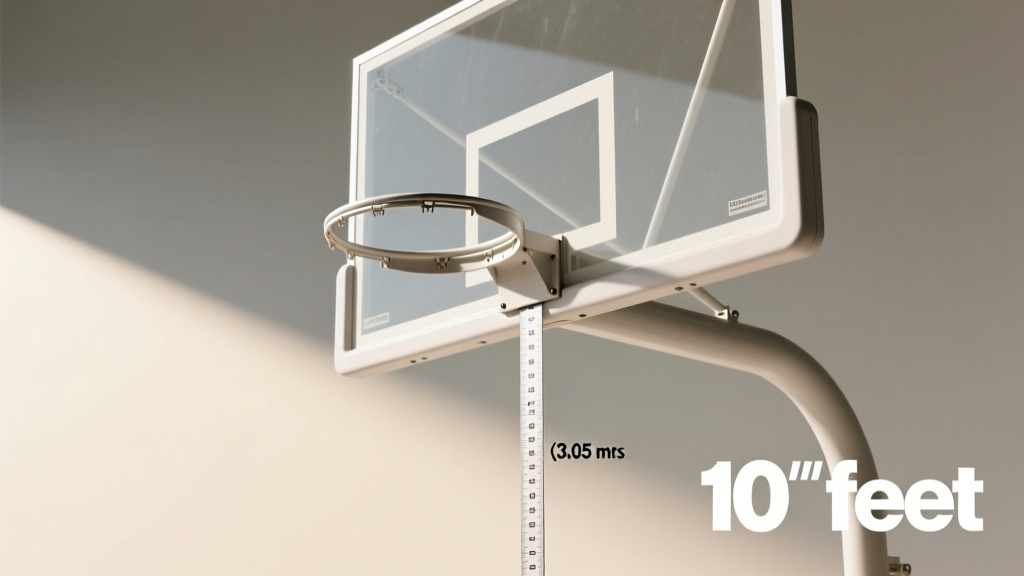 How Tall Are Basketball Hoops? Official Heights by Level
 How Many Fouls in Olympic Basketball Before Ejection?
 What Does SF Mean in Basketball? Explained
 When Did Kobe Start Playing Basketball? Early Years Revealed