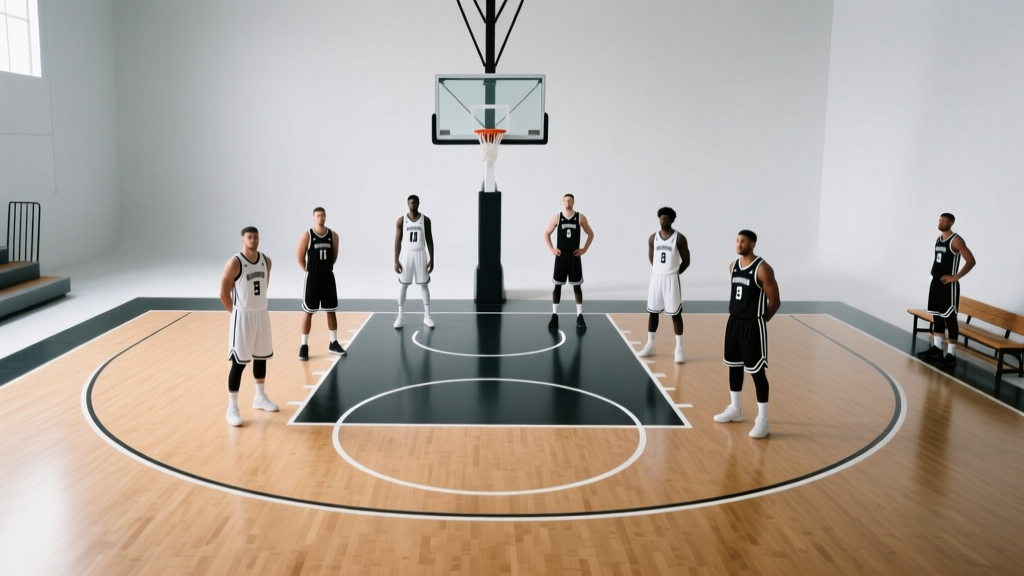
How Many People on a Basketball Team? Court & Roster Sizes
A standard basketball team consists of 5 players on the court at any given time, with additional substitutes on the bench. This structure is consistent across major leagues including the NBA, FIBA, WNBA, and NCAA.
Understanding Basketball Team Composition
Basketball is a team sport played between two teams, each aiming to score points by shooting the ball into the opponent's hoop. The number of players actively participating from each side is crucial for gameplay, strategy, and rule enforcement.
Core On-Court Players
The five starting players on a basketball team typically occupy specific positions that define their roles:
- Point Guard: Primary ball handler and playmaker
- Shooting Guard: Offensive scorer and perimeter defender
- Small Forward: Versatile scorer and rebounder
- Power Forward: Interior presence, rebounding, and defense
- Center: Dominant inside player, shot-blocker, and rim protector
Team Roster Sizes Across Leagues
While only five players are on the court, teams maintain larger rosters to allow for substitutions, rest, and strategic adjustments. Roster sizes vary slightly depending on the league and competition level.
| League/Organization | Players on Court | Total Roster Size | Substitutes Available | Season |
|---|---|---|---|---|
| NBA | 5 | 15 | 10 | 2024-2025 |
| WNBA | 5 | 12 | 7 | 2025 |
| NCAA Men's | 5 | 15 | 10 | 2024-2025 |
| NCAA Women's | 5 | 15 | 10 | 2024-2025 |
| FIBA International | 5 | 12 | 7 | 2025 |
| High School (NFHS) | 5 | 10-15 | 5-10 | 2024-2025 |
The data shows that while all leagues agree on 5 players per team on the court, roster sizes differ based on competitive demands and scheduling. The NBA and NCAA allow up to 15-player rosters, enabling deeper bench rotations and injury management. In contrast, FIBA and WNBA limit rosters to 12, emphasizing tighter squad control during international and professional seasons.
Why Five Players Per Team?
The use of five players per team dates back to basketball’s invention by Dr. James Naismith in 1891. Originally, there was no fixed number, but by the early 20th century, five became standardized due to court size, spacing, and balance between offense and defense.
Strategic Implications
- Spacing: Five players allow optimal floor coverage in a 94x50 foot court (NBA).
- Specialization: Each position has distinct responsibilities enhancing team synergy.
- Substitution Flexibility: Coaches can rotate players without disrupting flow.
- Foul Trouble Management: Having substitutes helps when key players accumulate fouls.
Variations in Non-Traditional Formats
Beyond standard 5-on-5 basketball, several formats exist with different player counts:
3x3 Basketball
Recognized by FIBA and included in the Olympics since 2020, 3x3 basketball features:
- 3 players on the court per team
- 1 substitute allowed
- Played on a half-court with one basket
- 10-minute game or first to 21 points
Youth and Recreational Leagues
Younger age groups often use fewer players to promote involvement and skill development:
- Ages 5–8: 3–5 players per side
- Middle School: 5 players, smaller courts
- Recreational Adult Leagues: Often follow FIBA or NBA standards
Frequently Asked Questions About Basketball Team Size
How many players are on a basketball team during a game?
There are 5 players from each team on the court at any time during a regulation basketball game. Additional substitutes remain on the bench and can be rotated in throughout the game.
How many total players are on a professional basketball team?
In the NBA, each team has a maximum of 15 players on its active roster, with 12 dressing for each game. The WNBA allows 12 players total per team, all eligible to play.
Can a basketball team play with fewer than 5 players?
Yes, if players foul out or are injured, a team may continue with fewer than 5 players. However, a team must have at least 2 players to start or continue a game, otherwise they forfeit.
What happens if a team has only 2 players left due to injuries or disqualifications?
If a team cannot field at least 2 players, the game is forfeited. If only 2 players remain, they may continue playing, though this is extremely rare in professional settings.
Why is it 5 on 5 in basketball instead of another number?
The 5-on-5 format evolved naturally from the game's early rules and court dimensions. It provides balanced spacing, role specialization, and strategic depth, making it ideal for competitive play.
How many players are on a college basketball team?
NCAA men’s and women’s basketball teams can carry up to 15 players on scholarship and non-scholarship rosters. Only 5 players are allowed on the court at once.
Is 3-on-3 basketball an official format?
Yes, 3x3 basketball is officially recognized by FIBA and has been part of the Olympic Games since Tokyo 2020. It uses 3 players per team with one substitute.
More Articles
 Don Bosco Prep Basketball: Program Overview & 2025 Stats
 USA Olympic Basketball Team: Full Roster and History
 What Position Did Michael Jordan Play in Basketball?
 How Many Games in NCAA Basketball Season?
 When Does Michigan State Play Basketball? 2025-2026 Schedule
 Who Won the NBA Championship in 2017? Full Recap
 What College Basketball Games Are On Tonight? Schedule & TV
 NCAA Mistakes: What Recruits and Coaches Get Wrong
 What Does Tenacity Mean in Basketball?
 Wisconsin Badgers Basketball Score Today & Recent Results