How Many Meters Is a Basketball Court?
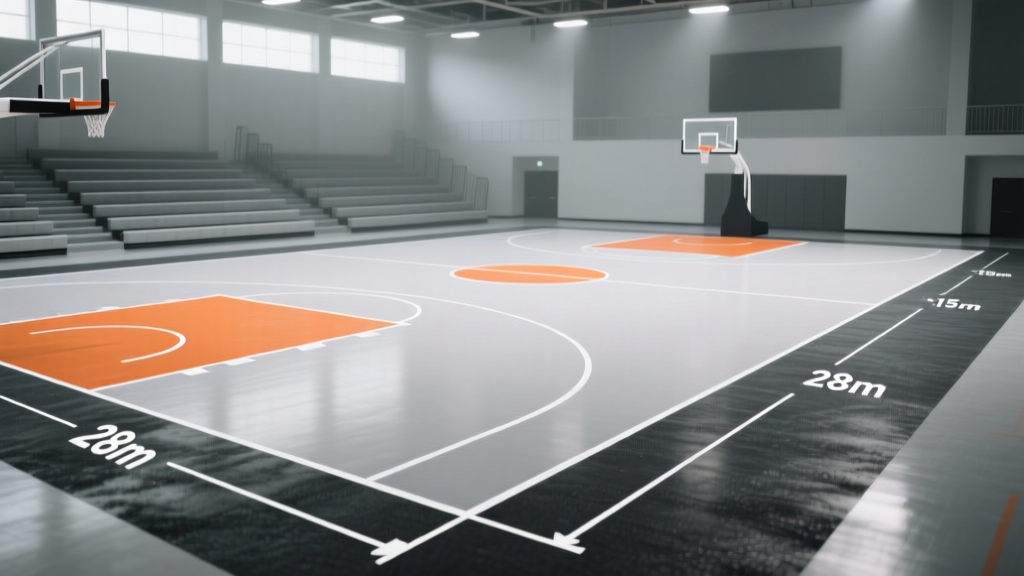
A standard full-size basketball court is 28 meters long and 15 meters wide, totaling a playing area of 420 square meters. This measurement is used in international competitions regulated by FIBA and differs slightly from the NBA, which uses imperial units. The court dimensions are critical for player spacing, game strategy, and official regulations.
Understanding Basketball Court Dimensions in Meters
Basketball courts vary slightly depending on the governing body and level of play. However, most international standards adhere to metric measurements established by FIBA (International Basketball Federation). Understanding the exact length and width in meters ensures proper facility planning, training accuracy, and compliance with competition rules.
Key Areas Measured in Meters
- Total court length: 28 meters
- Total court width: 15 meters
- Free-throw line distance from backboard: 5.8 meters
- Three-point line distance (varies by zone): 6.75 meters (arc), 6.6 meters (corners)
- Key (paint area) width: 4.9 meters
- Center circle diameter: 3.6 meters
FIBA vs. NBA Court Measurements
While both FIBA and NBA govern professional basketball, their court dimensions differ slightly. FIBA uses metric units, while the NBA traditionally uses feet but can be converted accurately into meters for global comparison.
| Feature | FIBA (meters) | NBA (converted to meters) |
|---|---|---|
| Court Length | 28.0 | 28.65 |
| Court Width | 15.0 | 15.24 |
| Three-Point Line (Arc) | 6.75 | 7.24 |
| Three-Point Line (Corner) | 6.60 | 7.24 |
| Free-Throw Line to Backboard | 5.80 | 5.80 |
| Key (Paint) Width | 4.90 | 4.88 |
| Backboard to Endline | 1.05 | 1.22 |
| Center Circle Diameter | 3.60 | 3.66 |
The table shows that FIBA courts are slightly smaller than NBA courts in both length and width. The three-point line is significantly shorter in FIBA play, especially at the top of the arc (6.75m vs 7.24m), giving guards more scoring opportunities. These differences impact player movement, spacing, and shooting strategy in international versus professional U.S. leagues.
Why Metric Measurements Matter in Global Basketball
Using meters ensures consistency across countries that follow the metric system. Most nations outside the United States use metric standards for construction, sports facilities, and education. Accurate conversion supports:
- International tournament preparation
- School and recreational facility design
- Player development programs aligned with FIBA standards
- Equipment manufacturing and flooring production
Basketball Court Size by Level of Play
Different levels of competition may use scaled-down versions of the full court, especially in youth or amateur settings.
Youth and Recreational Courts
- Half-court dimensions often used: 14m x 15m
- Mini-courts for children (ages 5–10): 18m x 10m
- Streetball or outdoor urban courts: typically 26m x 15m
These variations maintain proportional zones where possible, ensuring players learn correct spacing and shot distances early.
Frequently Asked Questions About Basketball Court Meters
How many meters is a full basketball court?
A full-size basketball court is 28 meters in length and 15 meters in width according to FIBA standards, covering a total area of 420 square meters.
What is the length of a basketball court in meters in the Olympics?
Olympic basketball courts follow FIBA regulations exactly, measuring 28 meters long and 15 meters wide, with a three-point line at 6.75 meters from the basket.
Is a basketball court 30 meters long?
No, a standard basketball court is not 30 meters long. FIBA courts are 28 meters long, while NBA courts are approximately 28.65 meters—still under 30 meters.
How far is the three-point line in meters?
In FIBA play, the three-point line is 6.75 meters from the basket at the top of the arc and 6.6 meters in the corners. In the NBA, it’s 7.24 meters all around.
How big is a half basketball court in meters?
A half basketball court is typically 14 meters long and 15 meters wide, maintaining the same width as a full court but halving the length for smaller venues or practice setups.
More Articles
 What Basketball Team Does Michael Jordan Own? | Full Details
 Who Plays NCAA Basketball Today? Schedule & Matchups
 How High Is a Basketball Goal? Official Heights by Level
 Who Won Basketball Last Night? Celtics Beat Lakers 112-105
 Where Is the Basketball Hall of Fame Located?
 What Channel Is the Wisconsin Badgers Game On?
 When Does the US Basketball Team Play? Schedule & Events
 Duke Basketball Game Today Start Time & How to Watch
 Who Is the Youngest Pro Basketball Player?
 What Does SF Mean in Basketball? Explained