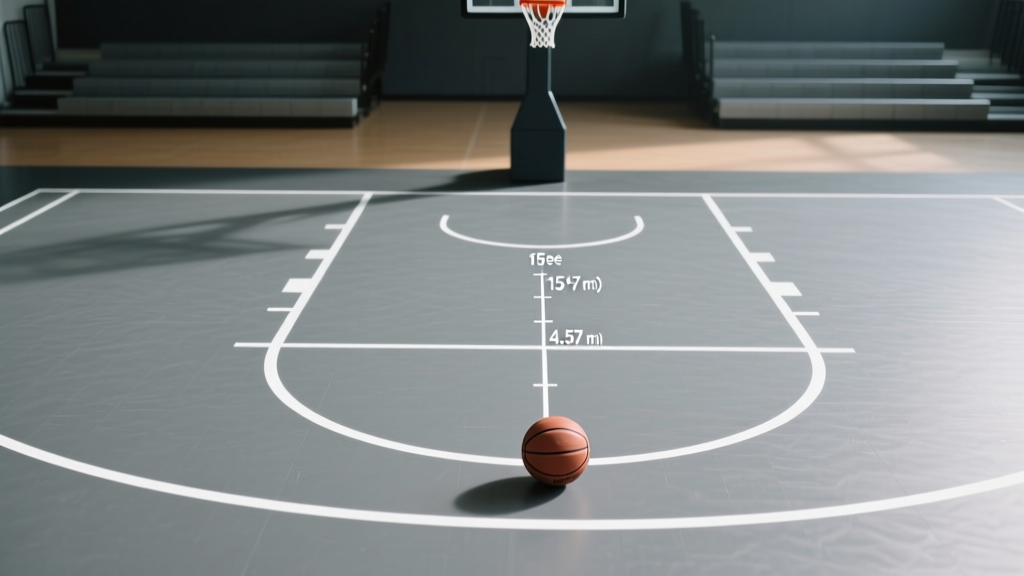
How Far Is a Free Throw Line in Basketball?
The free throw line in basketball is 15 feet (4.57 meters) from the backboard, measured horizontally. This distance is standardized across major leagues including the NBA, NCAA, FIBA, and high school basketball in the United States.
What Is a Free Throw Line?
A free throw line is a crucial marking on a basketball court used during foul shots. When a player is awarded a free throw, they must shoot from behind this line, attempting to score one point without defensive pressure.
Key Features of the Free Throw Line
- Located within the key (or paint area) near the basket
- Parallel to the baseline and directly in front of the hoop
- Players must remain behind the line until the ball leaves the shooter’s hand
- Violation results in a loss of the shot or potential rebound restrictions
Free Throw Line Distance Across Leagues
While the standard free throw distance is consistent in most organized basketball, slight variations in court dimensions may exist due to governing bodies. However, the horizontal distance from the backboard remains uniform.
| League/Organization | Free Throw Line to Backboard (feet) | Free Throw Line to Backboard (meters) | Free Throw Line to Center of Hoop (feet) | Free Throw Line to Center of Hoop (meters) |
|---|---|---|---|---|
| NBA | 15 | 4.57 | 13.75 | 4.19 |
| NCAA Men | 15 | 4.57 | 13.75 | 4.19 |
| NCAA Women | 15 | 4.57 | 13.75 | 4.19 |
| High School (NFHS) | 15 | 4.57 | 13.75 | 4.19 |
| FIBA | 15 | 4.57 | 13.75 | 4.19 |
| WNBA | 15 | 4.57 | 13.75 | 4.19 |
The data confirms that all major basketball organizations maintain a uniform free throw distance of 15 feet from the face of the backboard. The center of the rim is approximately 13.75 feet (4.19 m) from the free throw line due to the rim's 1.25-foot projection from the backboard. This consistency ensures fairness and skill comparability across levels of play.
History and Evolution of the Free Throw Line
Introduced in the early 20th century, the free throw line has remained largely unchanged. Originally, players could choose their shooting position, but standardization improved fairness. The 15-foot distance was adopted to balance scoring opportunity with difficulty.
Milestones in Free Throw Regulation
- 1890s: Free throws introduced after fouls
- 1924: 15-foot rule standardized by American colleges
- 1954: NBA adopts official 15-foot measurement
- 1984: Three-point line introduced, but free throw distance unchanged
Tips for Improving Free Throw Accuracy
Even at just 15 feet, elite players continually refine their technique. Here are proven strategies:
- Consistent Routine: Develop a pre-shot ritual to enhance focus
- Hand Placement: Use proper grip and follow-through (‘gooseneck’ wrist flick)
- Alignment: Feet shoulder-width apart, aligned with the rim
- Practice Under Fatigue: Simulate game conditions to improve mental resilience
- Video Analysis: Study form to correct imbalances
Famous Free Throw Shooters in Basketball History
Certain players have mastered the art of free throw shooting, achieving career averages above 90%:
- Stephen Curry – Career FT%: ~91%
- Steve Nash – Career FT%: 90.43% (NBA record)
- Mark Price – Career FT%: 90.39%
- Reggie Miller – Career FT%: 88.8%
- Devin Booker – Consistently over 90% in recent seasons
Common Questions About the Free Throw Line in Basketball
How far is the free throw line from the basket in feet?
The free throw line is 15 feet from the face of the backboard. Since the rim extends 1.25 feet from the backboard, the distance from the free throw line to the center of the basket is approximately 13.75 feet.
Is the free throw line the same distance in college and the NBA?
Yes, both the NBA and NCAA use the same 15-foot distance from the backboard to the free throw line. There is no difference in free throw distance between college and professional men’s or women’s basketball.
Why is the free throw line 15 feet from the backboard?
The 15-foot distance was established in the early 1900s to create a fair yet challenging one-point scoring opportunity. It balances accessibility with skill requirement, making it difficult enough to miss under pressure but close enough to reward accuracy.
Can you jump during a free throw?
Yes, players are allowed to jump forward or backward during a free throw as long as they do not step over the line before the ball hits the rim or backboard. Most players stay grounded to maintain balance and consistency.
What happens if you cross the free throw line too early?
If a shooter steps on or over the free throw line before the ball touches the rim or backboard, it’s a violation. The shot does not count even if made, and possession goes to the opposing team. Teammates must also stay behind the three-point line and outside the lane until the ball is released.
More Articles
 What College Basketball Games Are On Today? Full Schedule
 LeBron James' Position in Basketball Explained
 How Long Is College Basketball Halftime? (2025)
 How Many Laps Around a Basketball Court Is a Mile?
 How Many Basketball Teams Are in California? Full List
 The Science Behind Elite NBA Player Schedules: How Top Performers Optimize Rest, Recovery, and Performance
 How Tall Is an NBA Basketball Hoop? 10 Feet Explained
 Why Did James Naismith Invent Basketball?
 Who Won NCAA Basketball 2024? UConn Claims Title
 Basketball Court Size: Official Dimensions by League